For quick, durable repairs on plastic, epoxy glue is a top choice. This guide highlights five reliable epoxies that balance fast set times, strong bonding, and versatility across common plastic substrates. The selections are best for DIY repairs, automotive touch-ups, and hobby projects where a clear or color-matched finish is important. The table below helps compare core ideas at a glance.
| Product | Best For |
|---|---|
| Gorilla 2 Part Epoxy (0.85 oz) – Pack of 1 | Clear finish, quick set, general repairs |
| J-B Weld PlasticBonder (Tan) – 25 ml | Plastic repairs, gaps, automotive trim |
| Gorilla 2 Part Epoxy (0.85 oz) – Pack of 2 | Versatile, larger projects, gap filling |
| J-B Weld ClearWeld – 25 ml | Clear bond on multiple materials |
| J-B Weld KwikWeld – 6 Minute Set, 2 Pack | Fast repairs, tight schedules |
Gorilla 2 Part Epoxy, Clear Epoxy, 0.85 Ounce Syringe (Pack of 1)

Features: Dries clear for a clean finish; 5 minute set time allowing quick repositioning; acts as a gap filler to bond uneven or vertical surfaces. Best for household and automotive repairs where a discreet finish matters. The clear cure helps with finishing, and the 5-minute window supports precise alignment. Consider this option when you need a fast, transparent bond on plastics that will be visible after repair.
Best for: Small to medium plastic repairs where a clear, fast-setting bond is desired. Limitations: May require clamping for vertical gaps and is designed for non-porous plastics; ensure surfaces are clean for maximum hold.
J-B Weld PlasticBonder Body Panel Adhesive and Gap Filler Syringe – Black – 25 ml
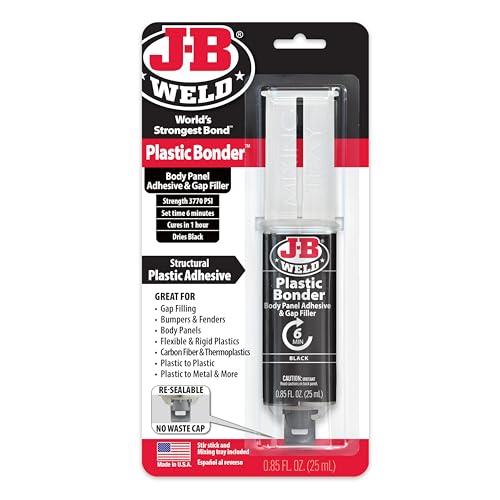
Features: Quick-set two-part urethane adhesive designed for plastics and composites; 1:1 mixing; sets in about 15 minutes with a final cure around 30 hours. Tensile strength around 3770 PSI. Best for DIY plastic repairs, bumper work, and gap filling on automotive panels. The tan color helps blends with certain plastic surfaces. A practical choice when working with flexible or coated plastics.
Best for: Plastic bumpers and panels where a strong, durable bond is needed. Limitations: Requires mixing and a full cure time; plan repairs accordingly for optimal strength.
J-B Weld 50112 ClearWeld 5 Minute Set Epoxy Syringe – Clear – 25 ml

Features: Clear resin formulation suitable for metal, tile, plastics, ceramic, glass, and wood; 1:1 syringe mix; sets in about 5 minutes with a 1-hour cure. Tensile strength around 3900 PSI. Best for work where a transparent bond is essential and speed is a factor. Suitable for lightweight repairs on translucent plastics or glass-adjacent surfaces.
Best for: Quick, clear bonds on mixed-material projects. Limitations: While durable, it may not be ideal for high-stress structural loads on thick plastics without adequate surface prep.
J-B Weld 6 Minute Set Epoxy KwikWeld – Dark Grey – 2 Pack

Features: Fast-setting two-part epoxy designed for multiple surfaces; 1:1 mix in a syringe; sets in about 6 minutes with 4-6 hour cure. Tensile strength about 3127 PSI. Best for time-sensitive repairs on plastics, metal, and composites where a quick return to service is needed. Comes in a dark grey color for applications where color matching to automotive interiors or machinery is helpful.
Best for: Rapid field repairs or projects with tight deadlines. Limitation: The dark grey tone may be visible on lighter surfaces; ensure color compatibility with the repair area.
J-B Weld PlasticWeld Quick-Setting Epoxy Syringe – Translucent Yellow – 25 ml
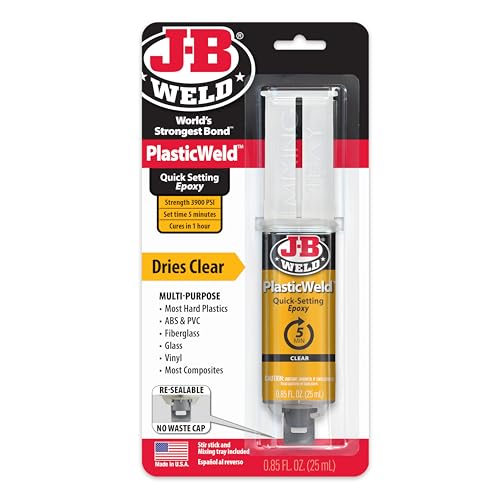
Features: Quick-setting two-part epoxy for a strong bond on many plastics; 1:1 syringe for easy mixing; sets in about 5 minutes and cures in 1 hour. Tensile strength around 3900 PSI. Best for plastic-to-plastic repairs, especially where a yellow-tinted bond is acceptable or not visible. The translucent yellow color can help mark repair areas while staying less conspicuous on some plastics.
Best for: Fast, plastic-specific repairs with a visible but non-obtrusive color. Limitation: Color may not blend on all plastics; test a small area first to ensure visibility meets expectations.
Buying Guide
What should I consider when choosing epoxy for plastic?
Material compatibility: Most epoxies work on common plastics like ABS, polycarbonate, and PVC. Verify that the product lists your plastic type in its compatibility notes.
Set time vs. working time: If you need time to reposition parts, choose a epoxy with a longer initial set. For fast repairs, select 5-6 minute options.
Finish and appearance: Clear or color-matched epoxies help maintain aesthetics on visible surfaces. Consider whether a colored or transparent bond is preferred.
Strength and cure: Tensile strength figures give a comparison of bond potential. Higher PSI usually means stronger bonds, but real-world performance depends on surface prep and load direction.
Gap filling: Some epoxies act as gap fillers, ideal for uneven surfaces or vertical bonds. This reduces the need for extra clamps or fillers.
Cure time and handling: Some formulations require longer cure times to reach full strength. Plan repairs accordingly to avoid premature stress.
Which epoxy is best for automotive plastic repairs?
For automotive applications, look for products marketed for plastic bonding with quick set times and strong tensile strength. Two-part epoxies like PlasticBonder or KwikWeld variants are common choices, especially when a 1:1 mix is convenient and the bond must endure temperature changes and vibration.
Which epoxy should I choose for a clear finish?
Clear epoxies are preferable when the repair surface is visible. The Gorilla 2 Part Epoxy in clear, or ClearWeld, provide transparent cures that minimize visibility on light-colored plastics.
How important is surface preparation?
Very important. Clean surfaces of oil, dust, and old adhesives. Lightly roughen smooth plastics to increase mechanical grip, then apply the epoxy as directed for best results.
What about waterproof or outdoor use?
Look for formulations advertised as waterproof or weather-resistant for outdoor or wet-area applications. These options often provide better performance under moisture exposure and temperature shifts.
Recommended quick reference answers
- Best all-around for plastics with clear finish: Gorilla 2 Part Epoxy (Pack of 1 or 2).
- Best for plastic bumper or panel repairs: J-B Weld PlasticBonder (Tan).
- Best fast-set clear bond: J-B Weld ClearWeld (5 minutes).
- Best for ultra-fast repairs with strong hold: J-B Weld KwikWeld (6 minutes).
- Best for general plastic bonding with fast cure: J-B Weld PlasticWeld (5 minutes).
FAQ
- Can epoxy be used on all plastics? Most common plastics are compatible, but always check the product’s material list before use.
- How long does it take for a full cure? Cure times vary; many epoxies reach full strength within 24 hours, but some are fully cured in 1 hour for handling.
- Is a syringe packaging important? Yes; syringes provide precise 1:1 mixing and reduce air exposure, improving consistency and shelf life.
- Can epoxy be painted over? Some epoxies are paintable after curing; verify paint compatibility on the product page or packaging.
- What is gap-filling capability? Several products act as gap fillers, making them suitable for uneven surfaces or gaps between parts.
- Do these products handle moisture? Waterproof formulations are available; choose a product labeled for moisture or outdoor use if exposure is expected.