Answering the common buyer question: which in-car charger delivers reliable, fast charging across multiple devices on road trips and daily commutes? This guide highlights five versatile options that balance power, safety, and convenience. Each pick suits different needs—from compact, clutter-free setups to retractable, multi-cable solutions for families. The summary table below helps you compare at a glance.
| Product | Port Count & Type | Max Power | Best For |
|---|---|---|---|
| KENHAO 67W 3-Port Car Charger | 2x USB-C, 1x USB-A | 67W total (PD 37W USB-C, QC 30W USB-A) | Tech-heavy devices; short trips with multiple passengers |
| BERTHALESS 4-in-1 Retractable Car Charger | 2 retractable cables + USB-A + USB-C | Not specified; high-capacity for four devices | Families and shared rides; minimal cable clutter |
| LISEN 69W USB-C Car Charger (2 Pack) | 1 USB-C port + 1 USB-A port | 36W USB-C PD + 18W USB-A QC | Balanced charging with fewer cables; practical everyday use |
| SUPERONE 99W Retractable Car Charger | Dual cables + USB-C / USB-A ports | Up to 99W total; PD 30W USB-C, 15W USB-C, 12W USB-A | Power users needing multiple devices with two retractable cables |
| LISEN Retractable USB-C Car Charger (Dual Cables) | Two built-in USB-C cables + USB-C / USB-A ports | Up to 75W total (two USB-C cables, 36W PD port) | USB-C-heavy setups; neat, retractable design |
Buyer note: the right choice depends on how many devices you charge, what ports you need (USB-C PD vs. USB-A), and whether you prefer a clutter-free interior or a higher-watt, multi-cable setup. The following sections cover each product in detail to help you decide.
KENHAO 67W 3-Port Car Charger

The KENHAO charger provides 67W total across three ports: a high-speed USB-C PD output up to 37W and a USB-A port up to 30W. It is designed for rapid charging of phones, tablets, and even laptops like MacBook Air on the road. The all-metal housing aids heat dissipation, and intelligent circuitry protects against over-current, over-voltage, overheating, and short circuits.
Best for tech-heavy travelers who frequently share a car with others and need reliable fast charging for multiple devices at once. Choose this if you want strong performance in a compact form factor. A potential limitation is that the available ports are split into USB-C and USB-A, so planning cable types matters for each device.
BERTHALESS Retractable Car Charger 4 in 1

This 4-in-1 charger features two retractable 80 cm cables plus USB-A and USB-C ports to support four devices simultaneously. It emphasizes safety with integrated protections against overcharging, over-current, and overheating. The retractable cables help keep your center console tidy when not in use.
Best for families or shared rides where cable management and multi-device charging are priorities. Use caution if you rely on high-watt PD charging for power-hungry devices, as the exact wattage per port isn’t specified and performance depends on the connected devices.
LISEN 69W USB-C Car Charger (2 Pack)
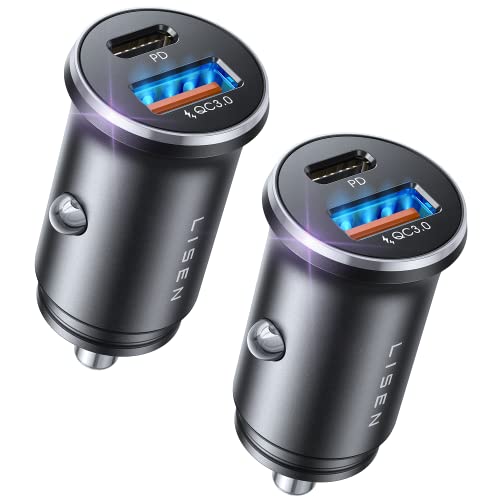
This dual-port charger reduces clutter by delivering one PD USB-C port and one USB-A port with smart power distribution. It targets real-world device charging: the USB-C PD supports fast charging for iPhone models and other USB-C devices, while the USB-A port covers a broad range of Android phones and tablets. The design aims to minimize heat buildup and avoid overloading a single outlet.
Best for drivers who want a balanced, low-noise charging setup without excess cables. If your devices require higher PD power consistently, verify the exact PD power for each port; some devices may charge more slowly if limits are reached.
SUPERONE 99W Retractable Car Charger

The SUPERONE charger emphasizes a high total wattage with a retractable design. It provides up to 99W total across multiple ports, including PD 30W USB-C and various USB-C/USB-A outputs. It also highlights two 80 cm retractable cables for flexible reach and organized interiors during trips.
Best for households or travelers who need to charge several devices at once with minimal cable clutter. The higher power budget is advantageous for charging larger devices like tablets or certain laptops. A potential limitation is that the per-port distribution isn’t always specified, so expect some variability depending on connected devices.
LISEN Retractable USB-C Car Charger (Dual Cables)
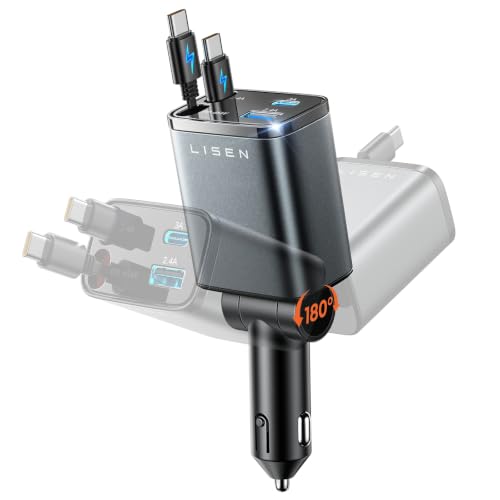
This LISEN model uses dual built-in USB-C cables with a retractable design to minimize clutter. It delivers up to 75W total with a 36W USB-C PD port and one USB-A port, allowing users to charge a phone, tablet, or laptop at the same time. The retractable cables help keep the cabin tidy and reduce cable damage over time.
Best for USB-C-heavy setups and travelers who prefer a tidy interior. If you primarily use USB-A devices, consider a model with a stronger USB-A allocation or separate USB-A ports for added flexibility.
Buying Guide
Key considerations for choosing an in-car charger:
- Power needs: Determine the total wattage you require across devices. If you frequently charge high-watt devices (laptops, iPads), prioritize models with PD-enabled USB-C ports and higher total wattage.
- Port variety: Decide whether you need USB-C PD, USB-A, or both. USB-C PD supports faster charging for newer devices; USB-A ports remain useful for older accessories.
- Retractable cables: If you want a cleaner cabin, retractable or built-in cables help reduce clutter. Check the number and length of cables to ensure compatibility with your seating arrangement.
- Safety features: Look for smart ICs and protections against over-current, over-voltage, overheating, and short circuits. Automatic shutoff when fully charged adds peace of mind during long trips.
- Vehicle compatibility: Most options support 12V-24V systems, but confirm compatibility with your car’s power outlet and fuse limits to avoid dimming or instability.
- Device variety: For households with multiple device types (phones, tablets, laptops), prefer multi-port chargers that distribute power efficiently without overheating.
Frequently Asked Questions
- What is PD charging and why does it matter in cars?
PD (Power Delivery) provides higher wattage through USB-C ports, enabling faster charging for compatible devices like newer iPhones, iPads, and some laptops. It matters in cars when you want to reduce charging time on the road.
- Should I choose a retractable cable charger?
Retractable designs reduce cable clutter and keep the console tidy. They are convenient for frequent passengers but verify the cable length to ensure reach to all seating positions.
- Is more total wattage always better?
Not necessarily. More wattage can speed up charging, but it depends on your devices’ requirements and port distribution. Efficient power sharing and safe design are also important.
- Are USB-A ports obsolete for in-car charging?
No. USB-A remains common and portable for older devices. Many models still pair USB-C PD with USB-A for broad compatibility.
- Can these chargers charge devices while the car is running?
Yes, most car chargers are designed to operate from the vehicle’s 12V-24V power outlet and will charge devices when the engine is on or in accessory mode, depending on vehicle electrical load.
- What if my device isn’t charging as fast as expected?
Check cable quality, port compatibility, and device settings. Some devices throttle charging based on temperature or battery health. Using a higher-wattery PD port can help, if supported.