Answering the needs of off-grid enthusiasts, RV owners, and small solar setups, these solar immersion controller options help manage charging from panels to batteries with minimal fuss. The top picks cover 12V and multi‑voltage systems, with clear monitoring, protection, and compatibility notes to help you pick the right controller for your needs. Best for: off-grid beginners, RV travelers, and DIY solar installers who want reliable charging and easy setup.
| Product | Best For | Key Benefit |
|---|---|---|
| [Upgraded] 30A PWM Solar Charge Controller with Auto Parameter LCD Display | Small to mid-size 12V/24V systems | Auto-adapts voltage; USB charging; auto parameter memorization |
| Renogy Wanderer Li 30A PWM Solar Charge Controller | RV and marine setups | 4-stage charging; versatile battery compatibility |
| PWM Solar Charge Controller 12V 20A for LiFePO4, AGM, Gel | Compact 12V systems with LiFePO4 or AGM | High-efficiency 20A PWM; zero idle drain |
| Renogy Wanderer 10A PWM Solar Charge Controller | Small panels and simple setups | Low wattage; IP32 waterproof rating |
| Waterproof IP67 Solar Boost-Buck MPPT Controller | Marine, RV, and humid outdoor use | IP67 sealing; wide input range; MPPT efficiency |
[Upgraded] 30A PWM Solar Charge Controller with Auto Parameter LCD Display

The Depvko controller is designed for automatic panel-to-battery management across 12V and 24V systems. It features a built-in microcontroller to memorize user settings and adapt to system voltage without manual reconfiguration. It includes a dual USB output for charging mobile devices, tablets, and laptops. Best for: off-grid hobbyists who want plug‑and‑play operation and convenient USB charging in 12V or 24V layouts. Limitation: Lithium or NiMH battery charging is not supported. Ensure the battery type is Lead-acid or equivalent for proper operation. This unit is suitable for compact solar installations in sheds, cabins, or small campers.
Renogy Wanderer Li 30A PWM Solar Charge Controller 12V

This Renogy Wanderer Li 30A controller optimizes charging for a range of battery chemistries and adapts automatically to 12V systems. It uses a 4-stage PWM charging scheme with full protections, and LEDs show real-time status. Best for: RVs, boats, or off‑grid systems where flexible battery management and straightforward monitoring are priorities. Choose this if you want broad battery compatibility and a compact, durable unit. Caution: Only 12V systems; not intended for 24V setups.
PWM Solar Charge Controller 12V 20A for LiFePO4, AGM, Gel

The AeternaSol 20A PWM controller is built for 12V systems and supports multiple battery chemistries, including LiFePO4 and lead-acid. It provides an LCD readout and easy plug‑and‑play installation with SAE connectors. Best for: small off‑grid setups, emergency kits, or marine use where a compact, reliable charger is needed. Limitation: Not compatible with 24V systems; ensure polarity is correct to prevent damage.
Renogy Wanderer 10A PWM Solar Charge Controller
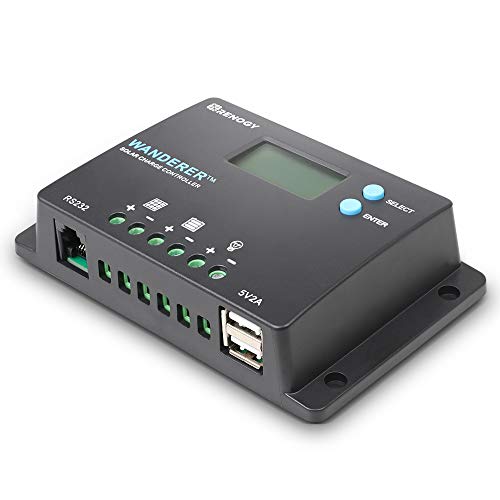
The Renogy Wanderer 10A controller uses 4-stage PWM charging to extend battery life for AGM, Gel, Flooded, and some Lithium chemistries. It includes auto protection against overcharge and reverse polarity and is designed for tight spaces with a compact footprint. Best for: compact RV solar setups and small boats. Limitation: Lower current output means it’s less suitable for larger solar arrays or high‑discharge devices.
Waterproof IP67 Solar Boost-Buck MPPT Controller

This IP67-rated MPPT controller handles a wide solar input range (13-60V) and charges 12V/24V/36V/48V batteries. It supports boost and buck charging, delivering high efficiency and robust protection for outdoor, marine, and off-grid environments. Best for: humid or wet locations, golf carts, RVs, and boats seeking higher efficiency from the same solar panels. Caution: IP67 rating emphasizes water exposure protection, but proper enclosure and mounting are still important to avoid direct immersion in harsh conditions.
Buying Guide
What to consider when choosing a solar immersion controller:
- System voltage and battery type: Match the controller to 12V, 24V, 36V, or 48V systems and to lead-acid, lithium, or gel chemistries.
- MPPT vs PWM: MPPT controllers harvest more energy, especially with higher panel voltages or larger arrays; PWM controllers are typically simpler and affordable for small setups.
- Current rating: Ensure the controller’s amperage can handle your solar array; oversizing helps future upgrades but may add cost.
- Protection features: Look for overload, reverse polarity, short-circuit, and temperature protections for safety and longevity.
- Monitoring interfaces: LCD or LED indicators, along with data readouts, help track charging status and performance.
- Physical environment: IP ratings and rugged casing matter for outdoor, marine, or off-grid installations exposed to weather.
- Install and wiring: Consider plug-and-play connectors, polarity safeguards, and space constraints in your enclosure.
Frequently Asked Questions
- What is the main difference between PWM and MPPT controllers?
Answer: PWM controllers are simpler and cheaper, suitable for smaller arrays. MPPT controllers optimize voltage to maximize power, especially with higher panel voltages or larger systems. - Can I use these controllers with lithium batteries?
Answer: Some controllers support lithium chemistries; verify the listed battery compatibility in the product features before purchase. - Do these controllers protect against reverse current?
Answer: Yes, most include anti-reverse diodes or similar protection to prevent battery drainage after sunset. - Are IP ratings important for outdoor installations?
Answer: Yes. Higher IP ratings (like IP67) mean better protection against water and dust, which is important for humid or wet environments. - Is it necessary to match system voltage to the controller’s input?
Answer: Yes. Using a 24V system with a controller only rated for 12V can cause malfunction or damage. - What should I check before wiring my controller?
Answer: Confirm correct polarity, ensure battery is properly charged for initial recognition (per manufacturer notes), and follow mounting instructions to avoid overheating.