When choosing a camera for your car, you want reliable front-and-rear recording, clear night vision, and easy connectivity. This guide highlights five top dash cams that balance image quality, features, and value for different drivers. Best for everyday commuters, rideshare drivers, road-trippers, or fleet operators, these options emphasize reliable parking modes, wide angles, and helpful sensors. Below is a quick buying table to compare the highlighted models at a glance.
| Product | Best For | Key Feature | Included Card |
|---|---|---|---|
| ROVE R2-4K Dual Dash Cam | Night-friendly detail | Upscaled 4K front, 1080p rear | 128GB |
| 70mai A810 Lite 4K | High-resolution front | 5GHz Wi‑Fi, GPS tracking | — |
| REDTIGER F7N TOUCH | Touch control lovers | 4K front, GPS, 5GHz Wi‑Fi | — |
| 360 View ZMOPO Dash Cam | Comprehensive coverage | 4-channel with left/right inside | 128GB |
| IIWEY N5 4 Channel Dash Cam | 360° coverage on a budget | 4-channel, 2K front | 128GB |
ROVE R2-4K Dual Dash Cam Front and Rear

The ROVE R2-4K Dual Dash Cam records the road ahead in 2.5K and upscales to 4K for sharper daytime footage, while the rear camera captures at 1080P. This setup is best for drivers who want clearer front detail, such as readable license plates and street signs, in both day and night conditions. The Sony STARVIS 2 IMX675 sensor and HDR help improve nighttime clarity for safer driving after dark or in tunnels. A built-in dual-band WiFi enables quick video transfers to a smartphone and over-the-air firmware updates.
Best for: drivers who need high-detail front footage and reliable night performance. Limitation: upscaled 4K is not native 4K, which may influence perceived sharpness on some displays.
Dash Cam Front and Rear, 3 Channel for Cars

This SUVCON model offers a triple-camera setup with a wide 170° front, 150° cabin, and 150° rear camera. It’s designed to minimize blind spots and includes a pre-bundled 32GB card. GPS-less but strong on parking monitoring and G-sensor features for locked clips when impacts are detected. Best for: drivers who want interior and exterior coverage in a compact package. Caution: the included card is smaller and may require an upgrade for longer trips.
70mai A810 Lite 4K Dash Cam Front and Rear

This 4K dual-camera system captures a front 3840×2160P image and a 1080P rear stream, delivering clear license plate and signage visibility. Key features include HDR night vision and a large-aperture F1.55 lens to improve low-light performance. Wi‑Fi 6 support allows faster transfers to a companion app for quick sharing and monitoring. Best for: drivers who want crisp daytime footage with strong night performance. Limitation: higher-resolution recording demands more storage and processing power.
REDTIGER 4K STARVIS 2 Dashcam Front Rear
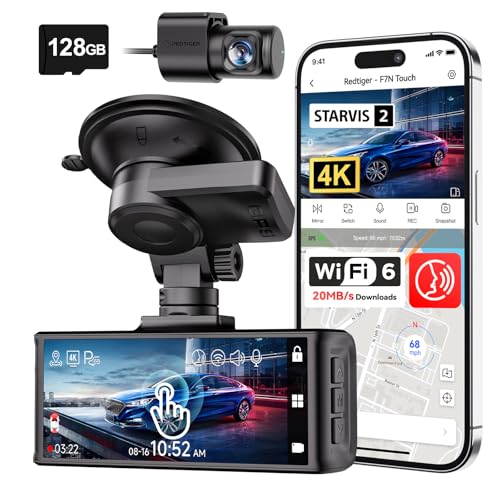
The REDTIGER F7N TOUCh delivers 4K front recording with 1080P rear, complemented by STARVIS 2 sensor and an HDR/WDR pipeline. Voice control and a touch screen simplify operation, while built-in GPS and 5.8GHz WiFi enable location tagging and quick wireless sharing. Best for: anyone who wants hands-free operation and precise route data. Caution: ensure wiring is secure since GPS and WiFi features rely on steady power and proper installation.
IIWEY N5 4 Channel Dash Cam

The IIWEY N5 4-channel system provides full vehicle coverage with four cameras and a 3″ IPS screen. It supports a 2.5K + 1080P + 1080P + 1080P recording mode, including 170° front and 150° side views. It uses a super-capacitor design and requires a constant power source, making it suitable for long drives or fleets. Best for: users who want all-around visibility and reliable power delivery. Limitation: must stay connected to a power source; battery-free design requires wired installation.
Buying Guide
What should you consider when choosing a dash cam?
Resolution and sensor quality determine how clearly details appear, especially license plates at night. Look for STARVIS or similar sensors and HDR/WDR to handle mixed lighting. A front-and-rear setup is common, but multi-channel (4-channel) models provide interior and side coverage for complete surveillance.
Storage, speed, and ease of use
- Check the included memory card and the maximum supported capacity.
- Look for loop recording that overwrites old footage to prevent card full interruptions.
- WiFi or app-based transfer speeds help quickly review and share clips after incidents.
Parking mode and safety features
Parking mode can be essential for vehicle security. Features like G-sensor, motion detection, and emergency locking ensure important clips are preserved when a vehicle is unattended.
Power and installation considerations
Some models use super-capacitors instead of batteries, which improves safety but requires a stable power source. Ensure your vehicle’s fuse box or a hardwired kit matches the dash cam’s power needs.
How to compare models quickly
- Best for night footage: prioritize low-light performance and HDR.
- Best for interior coverage: consider a 4-channel model with cabin cameras.
- Best for GPS and data logs: choose models with built-in GPS and precise logging.
FAQ
- What is the difference between 4K and upscaled 4K dash cams?
Answer: Upscaled 4K uses processing to approximate 4K detail from a lower native resolution, offering sharper footage but not true 4K quality. - Do dash cams require WiFi to function?
Answer: Most operate without WiFi; WiFi enables easier video transfer and remote control via apps. - Is a 4-channel dash cam worth it for everyday driving?
Answer: It depends on needs; interior and side coverage helps when monitoring passengers and side impacts in addition to road footage. - What is parking mode, and should I use it?
Answer: Parking mode records when the vehicle is parked or impacted, protecting footage of events away from driving sessions. - Do dash cams require professional installation?
Answer: Some models with multiple cameras are easier with professional wiring, but many can be installed by the user with basic tools.