Answering the top question buyers ask: what low-voltage cable works best for outdoor lighting setups? This guide highlights five reliable options suited for different project sizes and needs, from quick-path lighting to expansive yard displays. Each product is chosen for durability, direct burial readiness, and ease of use. Whether you’re a DIYer, a contractor, or upgrading a garden system, you’ll find clear reasons to choose one over another, plus a quick-buying table to compare essentials.
Summary of selected products
- Wirefy 14/2 Low Voltage Landscape Wire — 100 ft, direct burial, pure copper
- FIRMERST 14/2 Low Voltage Landscape Wire — 200 ft, direct burial ready
- SUNVIE 12/2 Low Voltage Landscape Wire — 250 ft, pure copper, direct burial
- Elite 16/2 Landscape Wire — 50 ft, pure copper, UL listed
- FIRMERST 16/2 Low Voltage Landscape Wire — 500 ft, direct burial
Wirefy 14/2 Low Voltage Landscape Wire

Best for small-to-medium DIY installations and garden accents. This 14/2 gauge wire is flexible, easy to strip, and rated for outdoor use with direct burial capability. It’s suitable for path lights, deck lighting, and underwater accents when run within its voltage limits. The copper composition supports reliable signal transmission and minimal voltage drop over moderate runs. This option is ideal for homeowners building or expanding a compact landscape lighting system.
Best for: DIYers starting a landscape-wiring project; best when runs are relatively short and routes are straightforward.
Caution: Avoid extremely long runs without verifying voltage drop calculations; consider stepping up to a thicker gauge for longer paths.
FIRMERST 14/2 Low Voltage Landscape Wire Outdoor Lighting Cable

This 14/2 wire comes in a 200-foot length with direct burial capability and a maximum working voltage around 150V, useful for low-voltage setups well under 30V. It’s designed to be flexible, easy to strip, and durable against sun exposure. It’s a solid choice for mid-sized landscape projects, including lighting along borders, around patios, or garden features where direct burial is feasible.
Best for: Projects needing longer runs in a single spool without stepping up to higher voltage constraints.
Caution: Designed for up to 150V; ensure your system stays within recommended low-voltage guidelines to keep brightness consistent.
GOSDENG 12/2 Low Voltage Landscape Wire 250FT
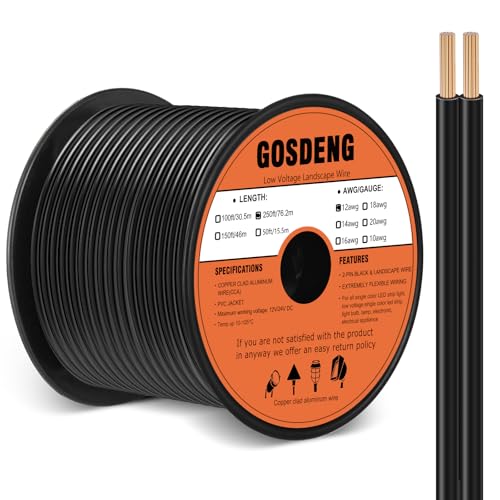
Best for medium-to-large landscape projects requiring more current-carrying capacity per run. This 12/2 wire uses copper-clad aluminum (CCA) and is direct burial ready, with a flexible build and good abrasion resistance. It’s lighter than pure copper while maintaining adequate conductivity for typical 12V landscape lighting. Suitable for longer pathways, fences, and larger garden beds needing stronger power delivery.
Best for: Larger outdoor layouts where a balance of cost and run length matters; critical for longer runs with a reasonable voltage drop.
Caution: CCA wire is lighter and less rigid than pure copper; consider conduit protection in high-traffic areas to avoid wear over time.
SUNVIE 12/2 Low Voltage Landscape Wire
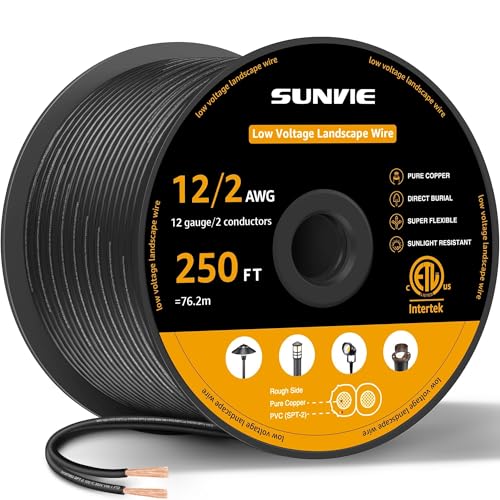
Best for long runs requiring stable brightness and minimal voltage drop. This 250-foot spool uses 12/2 conductors with pure copper insulation, claiming direct burial readiness and high conductivity. It’s designed to preserve brightness across extended distances, making it suitable for sizable yards, perimeter lighting, and feature lighting along long walkways.
Best for: Projects prioritizing voltage stability over long distances; ideal for larger properties with extended lighting layouts.
Caution: Verify burial depth and local trenching requirements to prevent exposure-related wear.
Elite 16/2 Landscape Lighting Wire

Best for smaller, detailed lighting setups with a focus on flexibility and ease of installation. This 16/2 gauge, pure copper wire is UL-listed and designed for direct burial, UV resistance, and outdoor durability. It’s a versatile choice for garden accents, path lighting, and water features where shorter runs are common and brightness must be consistent across zones.
Best for: Shorter, intricate lighting designs around patios, steps, or plant beds where pinpoint control matters.
Caution: Higher resistance per foot means voltage drop can become noticeable on longer runs; plan segment lengths accordingly.
FIRMERST 16/2 Low Voltage Landscape Wire
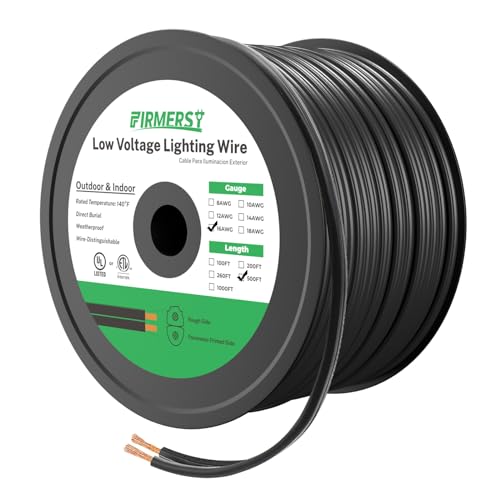
Best for large-scale, long-run installations where direct burial and durability are essential. The 500-foot spool of 16/2 wire is designed for direct burial and provides flexibility for extended layouts, including pathways, fences, and expansive garden lighting. It withstands sun exposure and is rated for substantial outdoor use, with a focus on long-term reliability in a low-voltage system.
Best for: Projects requiring extensive wiring with fewer splices and a single long run to reduce connections.
Caution: Ensure voltage drop is considered across very long runs; you may need sub-systems or a higher gauge if power needs are high at far distances.
Buying Guide: Key Considerations For Outdoor Lighting Wire
- Gauge and length: Choose gauge based on run distance and total wattage. Thicker gauges (12/2, 14/2, 16/2) handle longer runs and higher brightness with less voltage drop.
- Direct burial suitability: Look for wires explicitly rated for direct burial to avoid trenching and conduit requirements. UV resistance and moisture protection matter for exposed routes.
- Conductor material: Pure copper offers the best conductivity and lowest resistance. Copper-clad aluminum (CCA) is lighter and cheaper but with higher resistance and potential voltage drop over longer runs.
- Voltage and system design: Most landscape lighting uses low voltage (12V–30V). Stay within the recommended voltage range for each product to ensure safe operation and brightness.
- Flexibility and installation: Flexible wires are easier to route around obstacles. Consider pre-cut lengths vs. spools for project planning and waste reduction.
- Durability features: Look for insulation that resists sun exposure, moisture, and abrasion. Some products are designed with twist-tie or tangle-free properties for easier handling.
- Budget vs. performance: Higher gauge wire tends to cost more upfront but reduces voltage drop over distance, improving brightness at the end of long runs.
- Installation environment: For areas with heavy foot traffic or potential contact with soil, choose direct burial-rated and physically robust cable to minimize wear.
Frequently Asked Questions
- What gauge wire is best for a long outdoor lighting run?
For long runs, 12 AWG or 14 AWG is typically better than 16 AWG to minimize voltage drop. - Is direct burial wire safer than non-burial wire?
Direct burial-rated wire is designed to withstand moisture and soil contact, making it safer for underground installation. - Can I use copper-clad aluminum wire for landscape lighting?
Yes, it’s lighter and cheaper, but it has higher resistance and may cause more voltage drop on long runs. - How do I decide between 12/2 and 14/2 for a project?
Choose 12/2 for longer runs or higher brightness; 14/2 works well for shorter runs and typical garden lighting. - Do I need a transformer for 12V landscape lighting?
Most low-voltage systems require a transformer to step down from line voltage to 12V or 24V, depending on the kit. - What is the risk of using too thin wire for a large yard?
Thin wire can cause significant voltage drop, resulting in dimmer lights at the far end of the run.