Answering the search for high-quality analogue delay pedals, this guide highlights five top options that deliver warm, natural delay with reliable performance. These picks are ideal for guitarists seeking vintage echo tones, straightforward controls, and pedalboard-friendly sizes. Each section explains who it’s best for, why it stands out, and a practical caveat to consider.
| Product | Best For | Delay Range | Notes |
|---|---|---|---|
| MXR Carbon Copy Analog Delay | Players seeking classic tape-like repeats | Up to 600 ms | All-analog signal path |
| Donner Guitar Delay Pedal (Yellow Fall) | Compact boards, warm vintage feel | 20 ms – 620 ms | Mini pedal, true bypass |
| Pogolab Delay Pedal | Budget-friendly analogue with wet/dry control | Variable via TIME knob | Solid aluminum build |
| Walrus Fundamental Series Delay | versatile tones including digital/analog | Time control across modes | Multiple modes |
| JHS Pedals 3 Series Delay | Professional-sounding, versatile delays | 80 ms – 800 ms | American-made quality |
Overview: Each product below is evaluated for genuine analogue delay character, ease of use, and how well it fits common guitar rigs. The buying guide that follows helps you decide between true analogue, hybrid digital-analogue, and mode options, plus practical considerations like size, power, and reliability.
MXR Carbon Copy Analog Delay

The MXR Carbon Copy Analog Delay offers rich, all-analog delay with up to 600 milliseconds of delay time. Its ability to reproduce warm, tape-like repeats makes it a strong foundation for vintage styles and ambient textures. The lack of digital artifacts helps players maintain a natural echo that sits well in a guitar mix. Best for players who want a classic analogue voice with simple controls and reliable performance. A potential limitation is that the pedal’s features are straightforward; extra modulation or tone-shaping options require other pedals or external gear.
Donner Guitar Delay Pedal for Pedal Boards

This Donner analogue delay pedal provides 20 ms to 620 ms of delay with adjustable delay level and feedback, all in a compact aluminium-alloy chassis. Its vintage vibe is suitable for players aiming for warm, traditional echoes without adding a lot of footprint on the pedalboard. Best for players who need a small, durable analogue option with straightforward controls. Limitation: while compact, it offers fewer advanced features than higher-end models, such as extensive modulation options.
POGOLAB Delay Pedal

The Pogolab Delay Pedal emphasizes analog warmth with a TIME knob to adjust delay time and a Mix control for wet/dry balance. The pedal also includes a clear indicator light and a solid aluminum body. It is best for players who want an affordable analogue delay with the ability to dial in precise wet/dry balance and a warm echo. Caution: the feature set is basic, so users seeking advanced modulation, tap tempo, or extensive presets may want a different option.
JHS Pedals 3 Series Delay
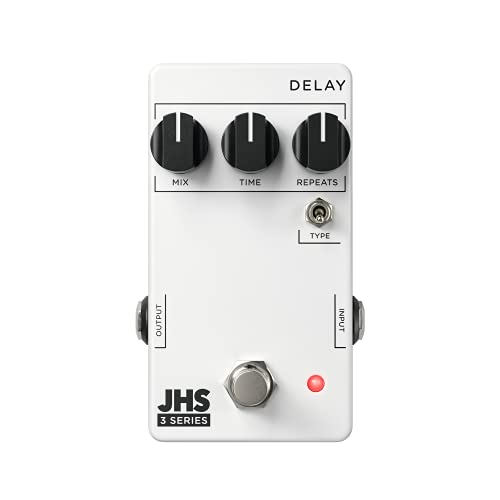
The JHS Pedals 3 Series Delay covers a broad range with 80 ms to 800 ms delay times and a Type toggle that switches between clearer digital-voiced delay and darker analog-voiced delay. Made in Kansas City, USA, this option is designed for players who want versatility across genres—from slapback to lush ambient echoes. Best for professionals or gigging players who value tonal flexibility and build quality. Limitation: higher price and complexity may be overkill for beginners or players who only need a simple echo.
Walrus Audio Fundamental Series Delay

The Walrus Fundamental Series Delay adds versatility with modes that cover Digital, Analog, and Reverse delays, plus time, feedback, and mix controls. It appeals to players who want a range of delay textures in a single pedal, from classic analogue warmth to more experimental digital echoes. Best for players who value a flexible, multi-mode approach. Caution: the multiple modes may require more study to dial in precise tones, especially in live settings.
Buying Guide: Key Considerations for Analogue Delay Pedals
What should you consider when choosing an analogue delay pedal? Here are practical questions and answers to help you decide:
- What delay range do you need? Analogue clones typically offer up to 600 ms, enough for subtle repeats or longer ambient swells. If you need longer echoes, consider pedals with digital or hybrid options.
- Do you want pure analogue signal or a digital-analog mix? Pure analogue paths yield warmer repeats, while digital or hybrid designs can offer more features like longer delay times or presets.
- Is tap tempo important? Some models include tap tempo, enabling precise, on-the-fly delay timing—great for live use and time-based effects.
- How important is size and power? Compact pedals save space, but some multi-mode options may be larger and require specific power supplies or daisy-chaining considerations.
- What about tonal options? Look for clean true bypass or buffered bypass depending on your pedalboard signal chain and length of cable runs.
- What’s your budget and skill level? Basic analogue pedals are straightforward for beginners, while mid-to-high-end models offer expanded tone-shaping and durability for experienced players.
Frequently Asked Questions
- What is analogue delay? Answer: Analogue delay uses traditional circuitry to generate echo repeats with warm saturation and natural decays, often preferred for vintage tones.
- Do analogue delays have modulation? Answer: Some offer optional modulation, but many classic pedals focus on delay repeats and level controls without built-in modulation.
- Is true bypass important for a delay pedal? Answer: True bypass minimizes signal coloration when the pedal is off, which can be important on a large pedalboard.
- Can I use an analogue delay with a digital amp modeler? Answer: Yes, but expect the analogue character to interact with the modeling in unique ways; you may want to experiment with level and mix settings.
- Should I choose a single-mode or multi-mode delay? Answer: Choose single-mode if you want a focused, simple echo. Choose multi-mode if you want a wide palette of delay textures in one pedal.
- Is budget a good indicator of quality for analogue delays? Answer: Not always; build quality, component choice, and the specific analogue circuit design matter as much as price.