When deciding which moisture meter to buy, consider where you’ll use it (indoor pots, outdoor beds, or garden plots), how deep you need readings, and whether you want simple meters or extra features like pH or temperature. The following five meters cover a range of uses from houseplants to large pots and outdoor gardens. Best for beginners: simple, easy-to-read meters; Best for deep pots: long probes; Best for multi-parameter care: 4-in-1 testers. Use this guide to match your plants’ watering needs with the right sensor.
| Product | Best For | Key Benefit |
|---|---|---|
| XLUX Long Probe Deep Use Soil Moisture Meter | Large pots, deep roots | Long 14 cm probe for deep soil readings |
| XLUX Soil Moisture Meter (Since 2015) | Beginner to intermediate | No batteries; clear 10-scale dial |
| Antonki 2 Pack Soil Moisture Meter | Multiple plants; budget-friendly | Two-pack value with color-coded dial |
| Tennedriv Green Soil Moisture Meter | Indoor houseplants | No batteries; simple and large gauge |
| YAMRON 4-in-1 Soil Moisture Meter | All-around plant care | Measures moisture, pH, temperature, sunlight |
XLUX Long Probe Deep Use Soil Moisture Meter

Best for deep pots and larger planters. This XLUX meter features a 5.5-inch (14 cm) probe that reaches deep into the soil to determine if it is dry, moist, or wet. The large dial displays ten scales in three zones for quick at-a-glance interpretation. Immediate readings help you water precisely where roots feed. A limitation is that the metal tip can corrode if left in soil for extended periods, so remove the probe after use.
- Long probe for deep-root measurements
- Easy-to-read dial with three zones and ten scales
- No batteries required
Who it’s best for: Gardeners with large pots, deep-rooted plants, or outdoor containers who want direct, quick readings without battery dependence. Choose this if you need moisture data from deeper soil layers and want a simple, mechanical reading.
XLUX Soil Moisture Meter (Since 2015) – Durable 304 Stainless Steel Probe
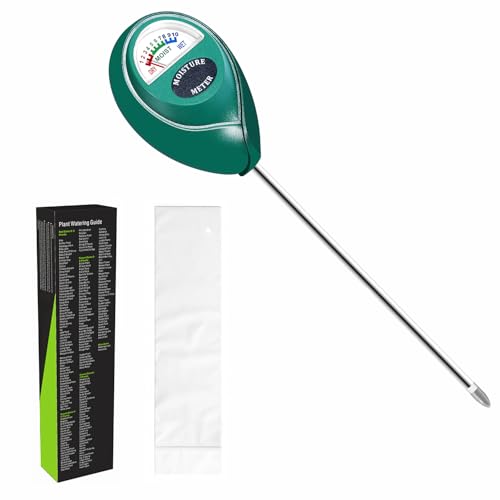
A reliable, long-standing option. This meter emphasizes durability and simplicity: no batteries, immediate readout, and a color-coded dial with 10 scales. The high-sensitivity probe targets the root zone for accurate moisture status. It’s ideal for users who want consistent performance from a trusted brand for indoor and outdoor plants alike. Note that the dial color coding helps distinguish between dry, moist, and wet soil at a glance.
- No batteries; instant readings
- 10-scale, color-coded dial (Dry–Moist–Wet)
- Proven track record and reliability
Who it’s best for: First-time meter users or seasoned gardeners seeking a simple, dependable tool with clear visual guidance. Better for ongoing, routine monitoring than for highly variable potting mixes.
Antonki 2 Pack Soil Moisture Meter

Best for budget-conscious buyers who care for multiple plants. This two-pack set offers quick, on-site moisture readings with a color-coded dial (red for dry, green for moist, blue for wet) across 10 scales, helping keep overwatering under control. It’s easy to use for indoor and outdoor plants alike. A potential limitation is that the meters rely on soil contact and may require occasional recalibration in very dense soils.
- Two-pack value for multi-plant care
- Color-coded, 10-scale dial for clarity
- No batteries required
Who it’s best for: Households with several potted plants or small gardens where a simple, economical meter is preferred. Choose this if you want multiple meters at a low cost.
Tennedriv Green Soil Moisture Meter

Simple, no-battery operation tailored for indoor houseplants. The meter reads moisture levels directly in the soil for quick watering decisions. It’s best for small to medium pots and for gardeners who prefer a straightforward, plug-and-read experience. A noted caution is that readings depend on stable soil contact; rocky or compacted soils can affect accuracy.
- No batteries required
- Large, easy-to-read gauge
- Ideal for indoor houseplants and small pots
Who it’s best for: Beginners or busy households seeking a dependable, low-maintenance option for routine plant care. Choose this if you want a straightforward device that works right away without setup.
YAMRON 4-in-1 Soil Moisture Meter

Best for comprehensive plant care in one tool. This 4-in-1 tester measures soil moisture, pH, temperature, and sunlight levels, helping you optimize watering and growing conditions across varied plant species. It’s suitable for gardens, potted plants, and outdoor beds. A limitation is that it uses batteries and a slightly more complex interface, which might be more than needed for simple watering tasks.
- Four functions in one device
- Backlit LCD display for easy readings
- Requires AAA batteries
Who it’s best for: Gardeners who want a multi-parameter tool to monitor light, pH, moisture, and temperature. Choose this if you manage diverse plants and require broader environmental data in one device.
Buying Guide: How To Choose The Right Plant Moisture Meter
- What is your typical planting setup? Indoor pots, outdoor beds, or large containers require different probe lengths and robustness. Long probes reach deeper roots; compact meters suit small pots.
- Do you prefer battery-free devices? If so, prioritize meters like XLUX or Antonki, which provide immediate readings without power.
- How precise do you need moisture readings to be? 10-scale dials offer simple guidance; some digital meters provide more precise numeric readings and extra features.
- Are you monitoring only moisture, or would you benefit from additional data (pH, temperature, sunlight)? 4-in-1 meters provide broader plant-care data but can be more complex.
- What is your tolerance for maintenance? Some meters require occasional cleaning to prevent corrosion or inaccurate readings in certain soils.
- Budget and plant variety: If you care for many plants, a multi-pack or two-pack option may offer better value per plant.
Frequently Asked Questions
- What is the main purpose of a soil moisture meter? Answer: To indicate whether the soil is dry, moist, or wet, helping prevent overwatering and underwatering by guiding when to water.
- Do I need batteries for most moisture meters? Answer: Many models are battery-free and rely on a mechanical dial or probe; some digital models require batteries.
- How deep should a moisture meter probe reach? Answer: For common potted plants, a probe around 5 to 14 cm covers most root zones; deeper pots benefit from longer probes.
- Can moisture meters test outdoor garden soils? Answer: Yes, many meters are designed for both indoor and outdoor use, but surface conditions and soil density can affect readings.
- Are pH or temperature readings important for watering decisions? Answer: For some plants, yes; pH affects nutrient availability, while temperature can influence water uptake and soil health.
- How should I care for my meter to extend life? Answer: Avoid leaving metal probes in soil for extended periods, wipe the probe after use, and clean soil off the tip to maintain accuracy.