Choosing the right 70-200mm lens can sharpen portraits, sports, and wildlife alike. This guide highlights five strong options, explaining who they suit and where to choose them. The list includes both Canon and Sony systems, plus a Sigma alternative, to help American buyers compare key features such as constant apertures, image stabilization, and build quality. Each entry notes the ideal buyer and a practical limitation to consider. Use this overview to decide which model matches your camera system and shooting goals.
Sigma 70-200mm F2.8 DG DN OS For Sony

This lens targets Sony E-mount and L-Mount users seeking fast, responsive performance with a constant f/2.8 aperture. The HLA AF motor delivers quick, smooth autofocus, ideal for action, events, and low-light portraits. Its dust and splash-resistant structure adds reliability in challenging outdoor conditions. Best for Sony shooters who want a bright tele-zoom with strong focus performance and weather resistance. A potential limitation is its larger weight and higher cost compared to f/4 options.
Canon EF 70-200mm f/4 L IS USM (Renewed)

Designed for Canon DSLRs, this f/4 L lens emphasizes lightweight handling with strong optical performance. Fluorite UD elements help maintain sharpness and contrast, while a USM motor provides fast, quiet AF. Closest focusing distance is about 3.94 feet, making it suitable for closer portraits and detail shots. Best for Canon users seeking a balance of portability, image quality, and stabilization. Limitation: the f/4 maximum aperture may be less ideal in low light compared with f/2.8 models.
Canon EF 75-300mm f/4-5.6 III Telephoto Zoom (Renewed)

This older Canon zoom covers a longer reach and is marketed toward budget-friendly setups. It uses a DC AF motor and offers a modest focal range (75-300mm) with a conservative aperture range. Best for casual shooters or beginners on a Canon body who want a basic telephoto option at a lower cost. Limitation: the variable aperture (f/4-5.6) reduces performance in dim lighting and offers less depth-of-field control than f/4 or f/2.8 models.
Canon RF70-200mm F4 L is USM

Canon’s lightest 70-200mm in the RF lineup, the f/4 L IS USM focuses on balance between weight and performance for EOS R-series shooters. It provides a constant f/4 aperture, reliable image stabilization with up to five stops of shake correction, and strong optics across the zoom range. Best for travel and sport photography where a light, weather-resistant lens benefits prolonged shoots. Limitation: the f/4 aperture may be limiting in very dim environments or for extreme shallow depth-of-field, compared to f/2.8 options.
Canon RF70-200mm F2.8 L is USM

The high-end option in the RF family, this lens delivers a bright f/2.8 aperture across the zoom range, compact and lightweight for a telephoto Zoom L lens, and effective stabilization with up to five stops of shake correction. Best for professional sports, wildlife, and portrait work where maximum light gathering and subject isolation are crucial. Limitation: higher weight and price; not compatible with non-RF Canon bodies.
Canon EF 70-200mm f/2.8L II USM (Renewed)
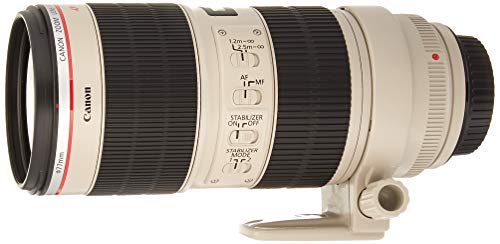
Canon’s legendary 70-200mm f/2.8L II USM offers a fast, constant f/2.8 aperture with a robust build and high optical performance across the frame. It is suited for professional portraiture, events, and sports where lighting is variable and subject separation matters. Best for Canon DSLR users who need shallow depth of field and strong edge-to-edge sharpness. Limitation: older mount and weight, plus availability primarily in renewed condition.
Buying Guide
What lens mount and camera system do you own? Align the product with your body type (Canon EF/RF, Sony E, or other). Consider aperture: f/2.8 gives brighter performance in low light and better subject isolation, while f/4 is lighter and often more affordable with reliable IS. How important is weight and size for travel or long shoots? Look for image stabilization efficiency and weather sealing for outdoor work. Do you shoot portraits, sports, or wildlife? For portraits, f/2.8 or f/4 with good bokeh helps; for action, fast AF and strong IS benefit faster lenses. Are you prioritizing zoom range or specialized optics? Some lenses emphasize edge-to-edge sharpness; others focus on close-focusing distance for close-crop shots. Also consider refurbished or renewed options if price sensitivity is high, ensuring the warranty terms meet your needs.
FAQ
- What is the benefit of a constant f/2.8 aperture on a 70-200mm lens? It maintains consistent brightness and depth of field across the zoom range, aiding low-light performance and subject isolation.
- Which 70-200mm lens is best for Canon EOS R mirrorless bodies? The Canon RF70-200mm f/4 L IS USM offers a lighter option with solid stabilization; the RF70-200mm f/2.8 L is USM provides maximum speed for professionals.
- Is image stabilization important on telephoto zooms? Yes, it helps compensate for camera shake at long focal lengths, enabling sharper hand-held shots in lower light.
- Should I buy a renewed 70-200mm lens? Renewed products can offer substantial savings, but verify warranty terms and condition details before purchasing.
- Which lens is best for travel? The Canon RF70-200mm f/4 L IS USM or similar lighter 70-200mm options balance weight, performance, and versatility for travelers.
- Do third-party options compete withCanon or Sony branded lenses? Third-party brands like Sigma can offer competitive speed, autofocus, and price, but review compatibility and support for your camera system.
Summary Table of Selected Models
| Product | Brand | Mount Type | Best For |
|---|---|---|---|
| Sigma 70-200mm F2.8 DG DN OS | Sigma | Sony E-language / L-Mount | Bright, fast AF for Sony mirrorless |
| Canon RF70-200mm F4 L IS USM | Canon | Canon RF | Travel, lighter weight, reliable IS |
| Canon RF70-200mm F2.8 L IS USM | Canon | Canon RF | Pro sports, high-speed action |
| Canon EF 70-200mm f/4L USM | Canon | Canon EF | Balanced performance on DSLRs |
| Sony FE 70-200mm F4 G OSS | Sony | Sony E | Compact, stabilized telephoto for Sony |