Looking for a beginner tattoo kit that delivers reliable power, safety, and ease of use? This guide highlights five standout options tailored for first-time tattooists, students, and hobbyists progressing toward professional practice. Each pick balances lightweight design, good battery life, and user-friendly features to help you practice clean lines and smooth shading. Below you’ll find who each kit is best for, why it’s recommended, and practical considerations to guide your choice.
Buyer snapshot table: Quick comparison of the five featured kits
| Product | Best For | Power | Key Benefit | Note |
|---|---|---|---|---|
| Neebol Wireless Tattoo Gun Kit (B0FJWRZ1H4) | Complete beginners and apprentices | Dual 1600mAh, up to ~6 hrs per battery | True wireless setup with long uptime | Ergonomic, lightweight |
| Wormhole Tattoo Gun Kit Uninterrupted Power Set (Auri WTK070) | New artists who want wired reliability | Wired power; no battery anxiety | Lightweight pen with adjustable depth | Includes comprehensive starter accessories |
| Dragonhawk L3 Wireless Tattoo Kit | Those needing flexible battery options | Two 2000mAh batteries; up to ~7 hrs | LED display and options for wired mode | Quiet, smooth motor |
| INKin Tattoo Kit for Beginners | All-in-one with stencil printer | Wireless with 1600mAh power | Stencil printer included for transfers | Large kit with multiple extras |
| LumenTip Wireless Tattoo Kit | Beginners seeking professional-grade setup | Wireless operation; stable power | High-performance rotary with minimal vibration | Complete professional set |
Neebol Wireless Tattoo Gun Kit, 2 Batteries for Beginners & Artists
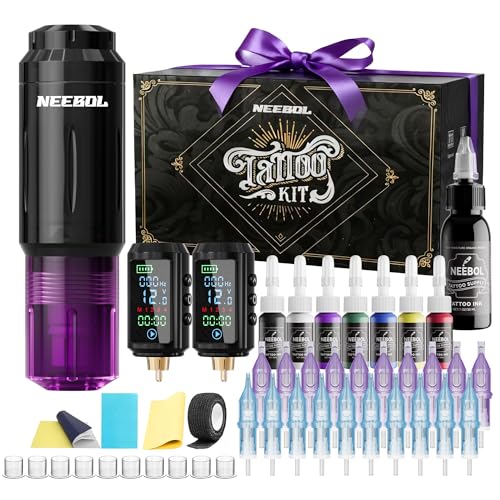
This kit centers on true wireless operation with dual 1600mAh batteries. It includes a wireless tattoo gun, two batteries, 20 needles, ink, and essential supplies—targeted at beginners, apprentices, and professionals seeking mobility. Best for practice and small-session tattooing where a cord-free setup improves workflow. A potential limitation is battery management; swap smoothly to maintain uninterrupted work.
Neebol Wirless Tattoo Gun Kit, 2 Batteries Set for Beginners & Artists

This listing mirrors the Neebol approach with a complete wireless kit designed for beginners and artists. It emphasizes long uptime and ergonomic design, aiming to reduce fatigue during longer sessions. Best for those who want a portable, cordless setup. Be aware that wireless systems rely on battery health; ensure you have proper charging habits to avoid downtime.
Dragonhawk L3 Wireless Tattoo Kit Mcore-L3 Motor

This kit highlights dual 2000mAh batteries with a switchable wired mode. Seven adjustable stroke settings support various techniques, from lining to shading. The Mcore motor reduces vibration for steadier handling. Best for learners who want a versatile tool that adapts as skills grow. A possible drawback is the need to learn stroke settings and voltage adjustments for optimal results.
INKin Tattoo Kit for Beginners with Stencil Printer

This all-in-one set includes a stencil printer, 7-stroke adjustable machine, 10 needles, transfer papers, practice skins, and ink. It’s best for beginners who want a comprehensive workflow solution from stencil creation to practice skin. Choose this if you value an integrated workflow; avoid if you prefer a minimal starter kit or want to source components separately.
HAWINK Tattoo Gun Kit with Power Supply LCD

This kit pairs a wireless gun with two 1600mAh batteries and a power supply option. It includes an LCD for voltage/battery status and memory/stippling features. Best for learners who want clear power feedback and a reliable, ergonomic design. Limitations may include the need to explore the memory function and stippling mode to maximize usability.
Neebol Wireless Tattoo Gun Kit, Complete Tattoo Set

This all-in-one Neebol kit focuses on ease of use for beginners with a complete set: wireless pen, 1600mAh battery, needles, ink, and practice skin. Best for students starting at home or in a studio, needing a full starter suite. A caveat is potential duplication with other Neebol listings; verify exact contents before purchasing.
Buying Guide
What to consider when choosing a beginner tattoo kit
- Power and mobility: Do you prefer wireless freedom or wired reliability? Dual-battery systems offer portability, but check runtime and charge cycles.
- Stroke options and motor: Look for adjustable strokes and a quiet, smooth motor to reduce hand fatigue and improve line work.
- Included accessories: Some kits add stencil printers, practice skins, or extra inks. Decide what you need to start immediately.
- Weight and ergonomics: A lightweight design minimizes fatigue during long practice sessions.
- Expandability: If you plan to advance, choose a kit that lets you adjust voltage, stroke, and needle depth as you learn.
- Maintenance and parts availability: Ensure compatible needles, ink, and spare parts are easy to source.
- Safety: Prioritize sterile accessories, skin practice materials, and clear handling instructions for safe practice at home or studio.
Practical buying questions
- Is wireless easier for beginners? Yes, it reduces cord clutter and can improve maneuverability, but ensure battery life meets your session length.
- Should I pick a kit with a stencil printer? If you want faster transfers and improved accuracy, a stencil printer adds value for beginners and small studios.
- What stroke range is best for learning? A middle range around 2.2–3.6 mm supports lining and shading without over- or under-penetration.
- Are two batteries worth it? Yes, for uninterrupted practice sessions; swap during breaks to maintain steady power.
FAQ
- What is included in a typical beginner tattoo kit? Most include a tattoo gun, power options (batteries or power supply), needles, ink, transfer materials, practice skin, and basic accessories.
- Can I tattoo at home with a beginner kit? It’s possible for practice on synthetic skin, but follow local regulations and hygiene practices if you plan real skin work in a studio setting.
- Do I need a stencil printer to start? Not always, but it helps with transfers and accuracy for beginners and PMU experiments.
- How long should practice sessions last? Start with 30–60 minutes and gradually increase as hand control and comfort improve.
- What maintenance is required? Clean and sterilize components, replace needles as needed, and recharge batteries according to manufacturer guidelines.
- Which kit is best overall for beginners? A kit offering a good balance of ergonomic design, reliable power, and complete starter supplies typically serves most new artists well.