The best budget bass amps deliver solid tone, portability, and value without breaking the bank. This guide highlights five affordable picks suited for beginners, practice-only players, and casual jammers who want reliable, portable sound. Each entry explains who benefits most, plus practical caveats to help you decide.
| Product | Best For | Key Benefit |
|---|---|---|
| Fender Rumble 15 V3 | Beginners and small gigs | Compact 15W with a Fender 8″ speaker for clear, punchy bass |
| GLARRY Full Size 20W Kit | New players with all-in-one starter kit | Complete starter package with 20W amp, cable, strap, and bag |
| GLARRY 20W Portable Combo | Home practice and small rooms | Lightweight, versatile tone controls for bedroom practice |
| JOYO Vibe Cube BA-30 | Travel players and livestreamers | 30W, Bluetooth, and compact for gigs or demos |
| demusea 20W Bass Amp | Budget-minded learners | 3-band EQ and portable build for easy practice |
Fender Rumble 15 V3 Bass Amplifier

The Fender Rumble 15 V3 is a compact 15-watt bass amp with an 8-inch Fender Special Design speaker. It provides a straightforward signal path and a top-mount control panel for quick tone tweaks. Best for beginners who need dependable practice sound in small spaces or for casual performers who want a lightweight option for quick setups.
Who it’s best for: beginners or players focused on home practice and small jam sessions. Why selected: the 15W output and Fender design deliver familiar bass tone in a portable package, with simple controls for fast setup. Caution: it’s not designed for loud stage use; consider a larger practice space or a bigger amp for gigs.
GLARRY Full Size Electric Bass Guitar Beginner Kit (Grey)

This GLARRY kit combines a full-size 4-string bass with a 20W amplifier, plus essential accessories like a cable, strap, and bag. It’s an all-in-one option ideal for new players who want everything in one purchase and a lightweight setup for practice at home or in a classroom. Best for: beginners on a tight budget seeking a ready-to-play package. Why selected: the bundle reduces extra shopping trips and ensures compatibility between guitar and amp. Limitation: focus is on entry-level features; more advanced players may want upgraded components later.
GLARRY Electric Bass Combo Amp 20W

This GLARRY 20W practice bass amplifier emphasizes portability with a compact form and essential tone controls (gain, volume, treble, bass, mid). It’s a solid choice for bedroom practice, quiet rehearsals, or small dorm rooms. Best for: players who want a lightweight, easy-to-use amp with straightforward EQ. Why selected: the combo’s balance of power and feature set suits learners who need reliable, silent practice options via headphones. Caution: it relies on a basic speaker for output; larger venues may require a bigger amp later.
JOYO Vibe Cube BA-30 Bass Amplifier

The JOYO BA-30 is a larger 30W portable amp with a 4″ speaker and built-in 3-band EQ plus a unique MID FREQ control. It also features Bluetooth 5.1 for backing tracks and an OTG recording option. Best for: players who perform live in small venues, stream performances, or need direct recording capability. Why selected: the extra power and Bluetooth/recording options offer versatility beyond a basic practice setup. Caution: Bluetooth reliability varies by device; if you need ultra-stable playback, consider wired options for critical practice sessions.
Demusea 20W Electric Bass Amplifier
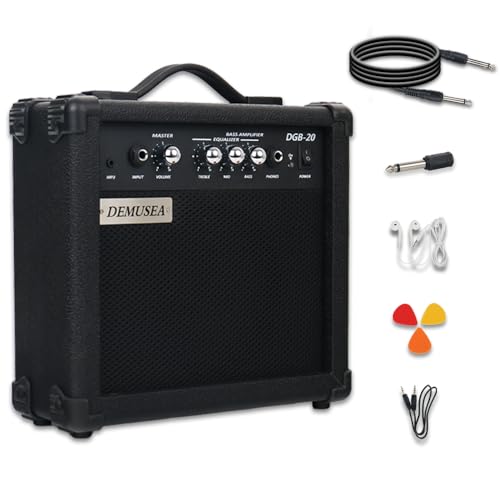
The Demusea 20W bass amp focuses on full-tone control with a 3-band EQ, a robust, portable design, and a durable build. It suits learners who want an affordable, all-around practice amp that’s easy to move between rooms or locations. Best for: budget-minded students and casual players seeking a basic but capable practice amp. Limitation: basic feature set means fewer tonal shapers for complex styles; consider pairing with external pedals for expanded sounds.
Buying Guide
Key purchase considerations for budget bass amps include power, size, tone controls, and portability. For beginners, prioritize simple controls and reliable build quality. If you practice quietly, look for headphone outputs or silent practice features. For small spaces or casual performances, aim for 15–30W with a capable speaker size (8″ to 12″). Portability matters if you travel or commute with your gear.
- Power needs: 15–30W covers most home practice and small gigs. Choose higher wattage if you anticipate louder environments.
- Speaker size: 8″ to 12″ speakers balance weight, footprint, and tone. Larger speakers typically deliver deeper lows but add weight.
- Tone shaping: at minimum, three-band EQ; additional controls (mid-frequency sweep, contour, drive) help fine-tune your sound.
- Connectivity: headphone out, aux in, Bluetooth, and direct recording options add flexibility for practice and demos.
- Portability: weight under 10 pounds is convenient for students and travelers; consider built-in handles and compact dimensions.
- All-in-one kits: bundles that include guitar, amp, and accessories can simplify shopping but verify component quality aligns with your goals.
Frequently Asked Questions
- What is a good budget bass amp for beginners?
- Do I need a separate cabinet or speaker for practice?
- Is Bluetooth on a bass amp useful?
- Should I buy a kit or individual components?
- What should I inspect when buying a budget amp?
A beginner-friendly option provides simple controls, reliable build, and adequate volume, such as a compact 15–20W amp with a legible EQ section.
Most budget amps include an integrated speaker suitable for home practice. Separate cabinets are usually unnecessary at entry level.
Bluetooth is convenient for backing tracks and playback during practice or demos, but avoid relying on it for critical timing in live sessions due to potential latency.
Starter kits can be cost-effective and convenient, especially for first-time players. Check that the included amp and bass meet your sound preferences before investing.
Look for solid construction, dependable input/output options, stable EQ controls, and a speaker rated for the stated power output. Avoid gear with unclear specifications or flimsy hardware.