Looking for an affordable delay pedal that still delivers usable, musical echo and space? This guide highlights budget-friendly delay pedals that suit beginners, hobbyists, and players upgrading from digital pedals to analog warmth. The top picks emphasize clear tone, practical controls, and reliable builds. Best for compact pedalboards, practice rooms, and affordable live rigs. Each product section explains who it’s best for and why it stands out at its price point. A quick buying guide follows to help compare features side by side.
Summary at a glance: the table below lists five budget-friendly delay pedals with key strengths for different needs.
| Product | Best For | Key Strength | Notable Limitation |
|---|---|---|---|
| Donner Guitar Delay Pedal (Yellow Fall) | Beginners and pedalboarders | Warm analog delay, compact form | Limited modern effects |
| SONICAKE Delay Reverb 2 in 1 | Live performers needing versatile space | Digital delay with plate reverb | Flood of options can be overwhelming |
| POGOLAB Delay Pedal | Budget-conscious tone purists | Analog warmth with mix control | Basic feature set |
| Donner Echo Square Delay Pedal | Players exploring multiple styles | Seven delay modes | Digital circuit with compact footprint |
| JOYO Digital Delay Effect Pedal (JF-08) | Tone-tailors wanting analog feel | Analog-voiced digital delay | Interface may feel limited for advanced users |
Donner Guitar Delay Pedal for Pedal Boards

Best for players who want a compact, true bypass analog delay on a budget. The Donner pedal reproduces warm vintage delay with 20ms to 620ms of delay time and adjustable delay level and feedback. It’s built in a durable aluminium-alloy housing and fits on pedalboards easily. This is a strong choice for beginners creating a classic delay texture without breaking the bank. Caution: it emphasizes analog warmth over digital presets, so players seeking long, modern echo tails should consider alternatives.
SONICAKE Delay Reverb 2 in 1

Best for performers who want two effects in one compact unit. This pedal provides digital delay up to 2000ms plus a plate reverb, with a large Decay parameter and features like Trail and Tap Tempo for live use. It’s better for players who want a versatile effect in a single stompbox and who can navigate a two-effect setup without external controllers. Limitation: as a digital combo, the tonal character shifts between modes, which may require dialing in separate presets for different songs.
Pogolab Delay Pedal

Best for players seeking analog warmth with straightforward control. Pogolab emphasizes analog delay with a time knob to adjust delay, plus a Mix control to blend wet and dry signals. Its solid aluminum construction and indicator light provide clear feedback during use. Choose this if you want an approachable, affordable analog delay with easy on/off status. Caution: lacks advanced digital features or a large memory footprint for complex presets.
Donner Echo Square Delay Pedal
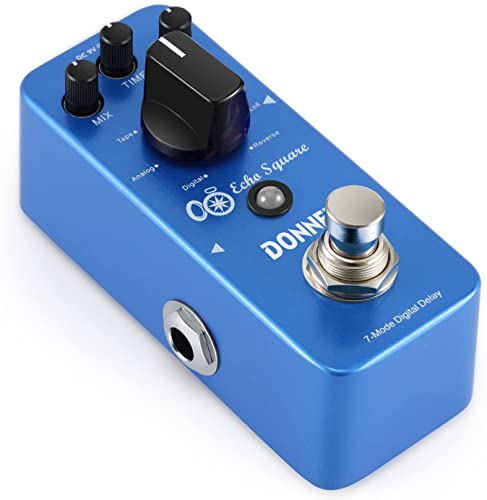
Best for players who want a multi-mode delay in a compact form. The Echo Square pedal offers seven delay modes, including digital, analog, tape, mod, sweep, lofi, and reverse. It uses a digital circuit design for reliable sound reproduction, with a true bypass switch to preserve tone when disengaged. Choose this if you want a single pedal capable of exploring multiple delay textures. Limitation: the broad mode range may require time to dial in the preferred sound for a given track.
JOYO Digital Delay Guitar Pedal (JF-08)

Best for players who want an analog-flavored delay from a digital circuit at a budget price. The JF-08 uses a special filter circuit to deliver warm, mellow character with a classic analog feel. Controls are simple: Time, Repeat, and Level, with true bypass to preserve tone. It’s a good entry point for those who value a smooth, vintage vibe without a steep learning curve. Caution: fewer advanced features for this price point can be limiting for complex live rigs.
Buying Guide: What To Check Before You Buy
Delay pedals come in analog and digital flavors. Analog tends to favor warmth and natural repeats, while digital provides clear, longer echoes and more precise timing. If you’re new, consider a pedal with true bypass to keep your guitar tone intact when off. Look at delay time range to ensure it covers your musical needs—from short slapbacks to longer ambient echoes. Also assess enclosure size, power requirements, and build quality for gigging or home use.
What delay time range do you need?
Short delays (20–100ms) work well for slapback and tight rhythms. Medium delays (100–600ms) suit many genres for space and shimmer. Long delays (600–1000ms) create ambient textures, provided your amp or other pedals can manage repeats without clutter.
Analog vs digital: which should you choose?
Analog delays offer warm, natural repeats and a classic vibe. Digital delays provide pristine repeats, longer time options, and more features like tap tempo and multiple modes. For classic rock and blues, an analog or analog-voiced option is ideal. For modern tones and ambient sounds, digital with multiple modes is more flexible.
Single-pedal vs multi-mode options
Single-mode pedals are simple and affordable, ideal for beginners. Multi-mode pedals offer a broader palette of textures in one unit, saving space but sometimes adding complexity. If you perform live across styles, a multi-mode unit can be advantageous.
How important is size and power?
Compact pedals save pedalboard space, but ensure you have a suitable 9V power supply or appropriate batteries. Check whether the pedal supports daisy chaining or isolated power to avoid nocturnal noise in your rig.
Frequently Asked Questions
Are budget delay pedals good for beginners?
Yes. They provide essential delay functions, simple controls, and a platform to learn timing and effects without a large investment.
What is true bypass and why does it matter?
True bypass preserves your guitar’s tone when the pedal is off, avoiding signal loss and high-end attenuation.
Can I use analog and digital delays together?
Yes. Many players place an analog delay first for warmth, then a digital delay for longer repeats or effects, creating a versatile chain.
How do I choose between 1 and multiple mode pedals?
Choose based on your style needs. One-pedal simplicity is great for beginners; multi-mode pedals suit players exploring diverse genres or live performance setups.
What should I consider for live gigs?
Look for reliability, easy-to-access controls, a sturdy enclosure, and a pedal with a clear bypass signal path to maintain tone when off.
Do these pedals require special power?
Most budget pedals use 9V DC power. Verify your power supply compatibility and consider isolated rails if you’re running many pedals to reduce noise.