If you want reliable whole-home wifi without breaking the bank, a budget mesh wifi system is the right choice. These systems are designed to eliminate dead zones, support multiple devices, and keep streaming smooth across large homes. Ideal buyers include condo dwellers seeking stable coverage, small to mid-size homes needing dependable performance, and budget-conscious households wanting easy setup with expandable coverage. The following picks balance price, performance, and ease of use for American buyers, with clear reasons to choose each option.
| Product | Best For | Why It Stands Out |
|---|---|---|
| TP-Link Deco X55 (3-Pack) | Medium to large homes | Wi‑Fi 6 with 6500 sq ft coverage and up to 150 devices |
| TP-Link Deco S4 (3-Pack) | Budget-conscious homes | Mesh with strong coverage up to 5500 sq ft and seamless roaming |
| TP-Link Deco 7 Pro (BE10000) Tri-Band | Large homes/tech enthusiasts | Wi‑Fi 7, 7-pack-capable mesh, extensive coverage |
| NETGEAR Orbi 770 Series (3-Pack) | Large homes needing high speed | Wi‑Fi 7 speeds, up to 8000 sq ft, enhanced backhaul |
| eero 7 Dual-Band (3-Pack) | Affordability with Wi‑Fi 7 | Future-proof with strong value and easy setup |
TP-Link Deco X55 AX3000 WiFi 6 Mesh System

The Deco X55 (3‑pack) delivers Wi‑Fi 6 with AX3000 speeds, designed to eliminate weak spots across up to 6500 square feet and support up to 150 devices. Best for households with multiple devices and streaming needs in larger homes, where stable coverage matters more than peak speed per device.
Why choose this: Strong overall coverage and future-ready performance without turning to higher-priced Wi‑Fi 7 systems. Caution: Actual speeds vary by walls and interference, as with any mesh setup.
TP-Link Deco S4 Mesh AC1900
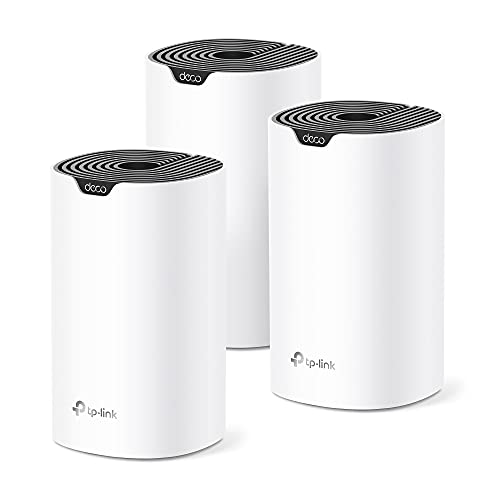
Deco S4 (3‑pack) provides reliable mesh coverage for homes up to 5500 square feet with seamless roaming and a single network name. It’s a practical choice for buyers who want straightforward setup and dependable performance at a friendly price.
Why choose this: Excellent value for average households needing solid whole-home coverage. Caution: Fewer high-end features than newer Wi‑Fi 6/7 models; may feel slower with many 4K streams or gaming on busy networks.
TP-Link Deco 7 Pro Tri-Band WiFi 7 BE10000

Deco 7 Pro is a tri‑band Wi‑Fi 7 system designed for expansive coverage, claiming up to 7,600 square feet and support for over 200 devices. It targets power users who want a future-ready mesh that can handle multiple bandwidth-heavy tasks simultaneously.
Why choose this: Best for tech enthusiasts seeking high capacity and top-tier speeds. Caution: Higher price point and more advanced setup complexity than entry-level mesh kits.
NETGEAR Orbi 770 Series (3-Pack)

The Orbi 770 Series is a Wi‑Fi 7 mesh kit offering up to 8000 square feet of coverage and high-end speeds, designed for large homes with many devices and demanding bandwidth needs. It emphasizes strong backhaul and broad reach.
Why choose this: Strong option for large properties requiring robust performance across many rooms. Caution: The feature set can be more complex to optimize for best results in some layouts.
Amazon eero 7 Dual-Band Mesh Wi-Fi 7

eero 7 offers an affordable route to Wi‑Fi 7 performance with 6,000 square feet of coverage in a 3‑pack configuration. It aims to minimize dead zones and provide a simple setup experience for homes new to mesh networking.
Why choose this: Great balance of price and future-proofing for small to mid‑sized homes. Caution: Dual-band design may underperform in ultra-dense networks compared to tri-band rivals in some scenarios.
Buying Guide
What to consider when choosing budget mesh wifi
- Coverage area: Measure your home and compare the stated square-foot coverage to avoid gaps. If your space includes multiple floors, look for systems that advertise multi‑room expansion.
- Wi‑Fi standard: Wi‑Fi 6 is solid and budget-friendly; Wi‑Fi 7 offers more headroom for dense networks and future devices, albeit at a higher price.
- Device capacity: If you have many smart devices, choose systems that advertise high device support and reliable backhaul.
- Backhaul type: Wired backhaul improves stability. Some systems are more flexible with wireless backhaul but may see performance dips under heavy use.
- Setup and management: Look for apps that simplify setup, guest networks, parental controls, and device prioritization.
- Expansion path: Ensure the kit can be expanded later with additional nodes if you later need more coverage.
FAQ
- What is the best budget mesh wifi for a large home? Answer: Systems advertising up to 6500–8000 square feet of coverage with reliable backhaul are strong contenders, such as tri‑band or Wi‑Fi 7 kits, depending on price and layout.
- Do Wi‑Fi 7 systems justify the cost for a typical home? Answer: They are most beneficial in dense networks with many devices or high bandwidth needs; otherwise, Wi‑Fi 6 can be more cost-efficient.
- Is a 3-pack sufficient for most homes? Answer: For many two-story homes, a 3-pack provides solid coverage; larger or multi-story homes may require a 4+ node setup.
- Should I prioritize backhaul options? Answer: Yes. Wired backhaul offers stability and speed, while wireless backhaul is easier to install but can reduce peak throughput.
- Can these systems work with existing routers? Answer: Mesh systems are typically used as the primary network, with the main unit connected to your modem; some models support passthrough if you keep a separate router.