If you’re shopping for a class D amplifier, you’re looking for efficient, compact power that delivers strong bass without overheating. This guide presents five solid choices suited for different needs—from compact home setups to demanding car subwoofers. The top picks cover different power levels, stability across ohm loads, and built-in features like bass boosts and remote level control. Here’s a quick overview to help decide which model fits your system and listening environment.
Summary table of selected products
| Product | Best For | Key Benefit | Limitations |
|---|---|---|---|
| Skar Audio RP-1200.1D | Garage or small-room subs | 1,200W RMS at 1Ω with bass boost | Remote control needed for full benefit |
| AUDIOZERONE ZE1000.1 | Heavy-duty subwoofers | 2,000W MAX, 1Ω stability, compact | Limited feature set compared to higher-end units |
| Skar Audio RP-800.1D | Balanced car bass | 800W RMS at 1Ω, compact footprint | Lower total power than larger models |
| AUDIOZERONE ZE500.1 | Mid-range car setups | 1,000W max, 1Ω stability, efficient | Fewer built-in adjustments |
| ORION CBA2000.1D | High-power mono subs | 2000W max, robust mono design | Requires careful installation |
Skar Audio RP-1200.1D Monoblock Class D Amplifier
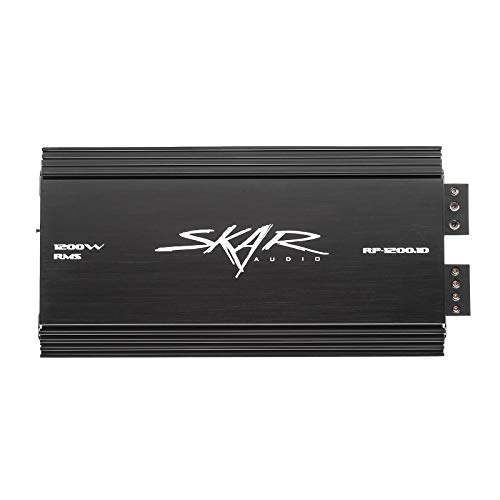
The RP-1200.1D is a strong choice for subwoofers in smaller spaces or compact builds. It operates as a monoblock Class D MOSFET amp with 1,600W peak power and 1,200W RMS at 1 Ohm. With a 20Hz to 250Hz frequency response, it emphasizes low-end output efficiently. A built-in bass EQ switch offers +6 or +12 dB boosts at 45Hz, allowing on-the-fly tailoring of bass presence. This model is best for a dedicated sub in a small to medium setup where space and power efficiency matter.
Who it’s best for: drivers seeking high power with a simple bass-boost option in a compact package. Why selected: the 1Ω stability and remote-capable control help tailor the listening experience without adding bulk. Caution: heat and electrical load management are essential in tight enclosures; ensure adequate ventilation.
AUDIOZERONE ZE1000.1 2000W Monoblock Class D

The ZE1000.1 delivers substantial power for heavy subwoofer demands. It’s a 1-channel mono amp rated at up to 2000W max at 1 Ohm with 1000W RMS at 1 Ohm, and 650W RMS at 2 Ohms. Class D design enhances efficiency, reducing heat generation and allowing smaller heat sinks. This unit is well-suited for bass-heavy systems in cars where peak power and size are critical. Best for: sub-centric builds needing high output in a compact form. Caution: power management should be paired with appropriately rated subs to avoid overloading the amp.
Skar Audio RP-800.1D Monoblock

The RP-800.1D offers a balanced option for car bass with 800W RMS at 1 Ohm and a peak of 1,200W. Its frequency response spans 20Hz to 250Hz, and it includes an on-board bass boost switch at 45Hz for +6 or +12 dB. Best for: users who want strong sub performance without the largest model. Choosing this model yields a good mix of power and size for medium-to-large sub setups. Limitation: lower overall power than the RP-1200.1D and ZE1000.1, so it may underperform on very demanding subs in open-air conditions.
AUDIOZERONE ZE500.1 1000W Mono

The ZE500.1 is a 1,000W max mono amplifier designed for stable 1–4 Ohm loads. It emphasizes efficient Class D operation, reducing power waste and heat. This unit is best for mid-range sub setups that require reliable performance with a compact footprint. Choose this if you want straightforward power without extra features. Caution: ensure your subwoofer and enclosure can handle the amplifier’s continuous power at 1 Ohm to avoid overheating.
ORION CBA2000.1D Cobalt Mono Amplifier

The ORION CBA2000.1D is a cobalt mono Class D amp designed for high-power car subwoofers. It’s built to continuously power loads of 1 Ohm while maintaining efficiency. The design emphasizes robust frequency response and a clear crossover network. This model is best for: bass enthusiasts needing large-scale output from a single channel. Limitation: installation quality significantly affects performance; improper setup can reduce efficiency and increase risk of overheating.
Buying Guide: Key Considerations For Class D Sub Amplifiers
- Power needs: Match RMS power at 1 Ohm with your subwoofer’s rating. Higher RMS power supports louder, deeper bass, but requires adequate electrical capacity and enclosure design.
- Impedance compatibility: Ensure the amplifier is stable at your sub’s impedance (1 Ohm, 2 Ohms, or 4 Ohms). 1 Ohm stability enables the highest output but demands careful heat management.
- Efficiency and heat: Class D is efficient, producing less heat than older classes. However, high-power setups still benefit from proper ventilation and a clean power source.
- Features: On-board bass boost, remote level control, and adjustable crossovers help tailor output to your vehicle or room acoustics. Consider if you need these controls for convenience or fine-tuning.
- Installation considerations: Mono amps require proper wiring and a secure ground. For multi-amp systems, plan speaker routing and fuse sizing to protect components.
- Physical footprint: If space is limited, prioritize compact models with sufficient power. Larger enclosures may limit placement options in cars or small rooms.
- System synergy: Pair a high-power amp with appropriately rated subs and compatible enclosure types. Mismatched components can limit performance and longevity.
Frequently Asked Questions
- What is Class D power and why choose it for subwoofers?
– Class D amplifiers use switching tech to deliver high efficiency, producing less heat and allowing smaller heat sinks, which is beneficial for subwoofers that demand substantial power. - Is 1 Ohm stability important for car subwoofers?
– Yes. 1 Ohm stability enables higher peak power, but it requires robust electrical setups and proper cooling to avoid thermal issues. - Do I need a remote subwoofer control?
– It’s useful for quick level adjustments from the seating position, especially in loud environments where reaching the amp is inconvenient. - Can I run multiple amps in one system?
– Yes, but plan wiring, fusing, and impedance to prevent overloading components and ensure balanced output across subs. - What should I consider when choosing a class D amp for home use?
– For home use, consider size, noise floor, and the ability to drive bookshelf or larger passive speakers, though many class D amps are designed for car audio and may need adaptation for home setups.