Finding the right delay pedal depends on your style, rig, and whether you crave lush analog warmth or precise digital repeats. This guide highlights five delay pedals that cover classic, versatile, and modern needs. Whether you’re a touring guitarist, home-recording enthusiast, or pedalboard planner, these picks help you achieve characteristic repeats, space, and tempo control. The featured products are chosen for tone, build quality, and practical features like true bypass, tap tempo, or built-in looper. Each entry explains who it’s best for and why it stands out, with quick cautions when relevant. A concise buying guide follows to help you compare options at a glance.
| Product | Best For | Key Benefit |
|---|---|---|
| Donner Analog Delay | Budget buyers seeking vintage warmth | Compact, pedalboard-friendly with true bypass |
| SONICAKE Delay Reverb 2-in-1 | Live players needing delay plus reverb | Two effects in one, long delay times |
| BOSS DD-8 Digital Delay | Professional or versatile gig rig | Multiple modes and built-in looper |
| Pogolab Delay Pedal | Analog lovers on a budget | Warm analog voice, solid build |
| MXR Carbon Copy Analog Delay | Classic analog with reliability | Rich tone, up to 600 ms, modulation |
Donner Guitar Delay Pedal: Vintage Vibe On A Mini Pedalboard

The Donner Analog Delay is designed for players who want warm, vintage-tinged repeats without a large footprint. Its 20 ms to 620 ms delay range offers short slapback through longer ambient lines, making it versatile for blues, indie, and classic rock textures. The pedal provides a straightforward control set: delay level and feedback, so you can dial in subtle echoes or pronounced repeats. Built with an aluminum-alloy chassis, its compact form fits well on crowded pedalboards and stands up to travel. This is best for budget-conscious players who value a true bypass signal path and a recognizable vintage character without sacrificing reliability.
Best for: beginners and travelers who need a straightforward analog tone in a small package. A potential limitation is the absence of extra features like tap tempo or modulation, which means you’ll rely on your playing to set rhythm or add external timing devices.
SONICAKE Delay Reverb 2 in 1: Digital Delay With Plate Reverb

The SONICAKE Delay Reverb 2-in-1 provides two essential effects in one compact unit: digital delay and plate reverb. It supports up to 2000 ms of delay, enabling long, spacious echoes suitable for ambient tones and wash textures. Reverb’s sizeable decay control helps shape room and plate characteristics, while a trail function helps maintain ambient continuity during live performances. A built-in tap tempo feature supports precise timing in live or studio settings. This pedal is particularly attractive for players who want a single, travel-friendly box to expand both delay and reverb capabilities without adding extra pedals.
Best for: players who need a versatile, space-efficient solution for both delay and reverb. Caution: as a budget-friendly digital option, the depth of analog warmth may be less pronounced than dedicated analog pedals.
BOSS DD-8 Digital Delay: The Most Versatile Compact Delay

The BOSS DD-8 digital delay stands out for versatility in a compact unit. It offers multiple delay modes, including standard digital delay, vintage echo flavors, shimmer, and modulation-based options. Its built-in looper provides up to 40 seconds of recording time with overdub capability, making it a strong choice for players who need songwriting or live looping alongside delay. The DD-8 is designed for professional rigs with reliable, predictable performance, plus three-pedal operation when used with external footswitches. This pedal is best for players who want a broad palette of delay tones and a practical looping feature in a single box.
Best for: performers requiring diverse delay textures and a dependable onboard looper. Limitation: the more features can add complexity for beginners who prefer a simpler analog path.
Pogolab Delay Pedal: Budget Analog With Solid Build

The Pogolab Delay Pedal emphasizes warm analog delay with a user-friendly interface. Its design provides a dedicated Time knob to set delay length and a Mix control to blend wet and dry signals for desired presence in the mix. The aluminum alloy chassis enhances durability while the indicator light helps confirm operation in live settings. This pedal is a strong option for players who want a straightforward analog voice without extra features that complicate tone shaping. It’s well-suited for small rigs or as a budget-friendly upgrade to an existing pedalboard.
Best for: players who want honest analog warmth with a simple, robust control layout. Caution: it may lack tap tempo or deep modulation options found on more feature-rich pedals.
JHS Pedals 3 Series Delay
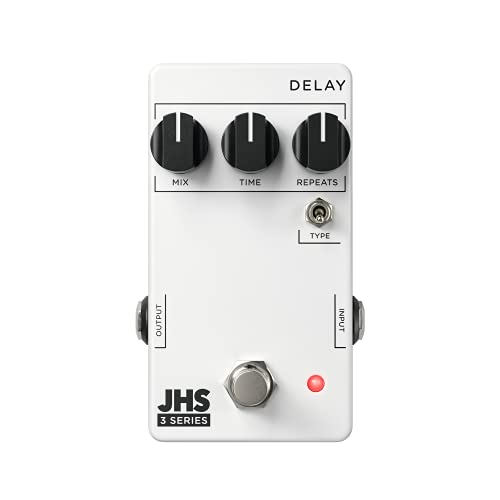
The JHS Pedals 3 Series Delay is a versatile, adaptable option that covers a range from short slapback to long ambient delays. With a delay range of 80 ms to 800 ms, it accommodates tight rhythm work as well as expansive soundscapes. The Type toggle lets you choose between a clearer digital-voiced delay and a darker analog-voiced delay, enabling quick tonal shifts in live performance or studio work. This pedal is best for players who want a high-quality, US-made option with tonal flexibility and straightforward controls. A potential limitation is the need to explore different modes to find the exact vibe for a given track or band setting.
Best for: players seeking classic and modern delay textures with easy mode-switching. Choose this if you want a premium, toneful delay that remains musical across genres.
Buying Guide: Key Considerations For Delay Pedals
- Analog vs Digital: Analog delays (warmth and natural repeats) versus digital delays (clean, precise repeats and longer delay times) impact your overall tone. Consider your guitar, amp, and preferred genre when choosing.
- Delay Time And Range: For riffs, slapback, and short cues, 50-250 ms is common. For ambient pads, you’ll want 500 ms to 1,000 ms or more. Check the maximum delay time and whether it supports tap tempo for rhythm synchronization.
- Mode Variety: A broader set of modes (digital, analog, modulation, looper, shimmer) allows more tonal options in one pedal, reducing the need for additional pedals on stage.
- Signal Integrity: True bypass preserves your guitar’s tone when the effect is off. Some digital pedals use buffered paths that can affect tone; consider this if you’re chasing a pure signal path.
- Built-in Looper And Expression: A built-in looper is valuable for practice, songwriting, and live layering. An external expression pedal can add real-time control over time or mix.
- Build And Footprint: Durable construction and pedalboard-friendly size help with reliability on tour and easy transport. Aluminum chassis generally offer ruggedness for gigging players.
- Ease Of Use: Simple controls are essential for live settings. Pedals with links to tempo controls or clear labeling reduce setup time and errors during performances.
Frequently Asked Questions
- What’s the difference between analog and digital delay?
- Is a looper essential in a delay pedal?
- Should I choose a delay pedal with tap tempo?
- Can I use delay pedals with MIDI or expression pedals?
- What is “true bypass” and why does it matter?
- How many delays should I carry on a gig?
Analog delay uses natural, frequency-based degradation for repeats, producing warmer, more colored echoes. Digital delay uses sampling and playback for clean, precise repeats with the option for longer delay times and variable tonal shapes.
Not essential, but a built-in looper increases live performance flexibility. It’s especially helpful for players who layer parts or practice ideas on stage.
Tap tempo is highly beneficial for locking delays to your tempo in live settings. If you play with a band or along tracks, it helps keep repeats in sync.
Many delay pedals support external footswitches or expression pedals for real-time control. Check each model’s inputs and compatibility to plan your rig.
True bypass minimizes signal coloration when the pedal is off, preserving your guitar’s tone. It’s a key consideration for players prioritizing a transparent signal chain.
For most players, one or two delay pedals covering analog warmth and digital versatility is enough. For ambient players or session work, a single multi-mode pedal with a looper can replace several devices.