Answering the common question “which guitar volume pedal should I buy?” this guide highlights five reliable options that suit different setups—from compact boards to passive signal chains. Best for pedalboard-savers and players seeking reliable passive control are Ernie Ball VP JR 250K and the 40th Anniversary edition. For dual-function control, Lefiko’s Volume & Expression Pedal blends volume and expression in one compact unit. SONICAKE’s EXP pedal is a compact, passive choice with easy switching between volume and expression. Jim Dunlop’s Volume (X) Pedal offers full-size control and proven durability for live performance. This overview helps players choose based on signal type (passive vs active), form factor, and practical limitations.
Buyer-focused summary table:
| Product | Best For | Key Benefit | Limitations |
|---|---|---|---|
| Ernie Ball VP JR 250K Volume Pedal | Passive signals on compact boards | Small footprint with mono volume control and taper switch | Only mono control; limited to passive signals |
| Ernie Ball 40th Anniversary Volume Pedal | Active or passive signals on a disruption-free board | Limited edition, precise volume with Kevlar cord | Limited edition; availability varies |
| Lefiko Volume & Expression Pedal | Dual function without extra pedals | Volume and expression in one, passive and simple | Requires TRS cable for full expression control |
| SONICAKE Passive Volume & Expression EXP Pedal | Compact setups needing two controls | Passive, silent operation with dual control modes | Small form factor may limit hand feel for some players |
| Jim Dunlop Volume (X) Pedal | Full-size, reliable volume and effects control | Pro-grade control, large rocker for precise swells | Full-size footprint; traditional design |
Ernie Ball VP JR 250K Volume Pedal, For Passive Signals

Brand: Ernie Ball
Features: Jr size to better fit on pedal boards, Mono volume control, Taper switch for two distinctive swell rates
Best for: Musicians who need a compact footprint on pedalboards while controlling a passive guitar signal. The mono control with two swell rates provides flexibility for subtle or more pronounced volume swells.
Limitations: Designed for passive signals; may not be ideal for players who require stereo or advanced multi-parameter control in a single unit.
Ernie Ball 40th Anniversary Volume Pedal

Brand: Ernie Ball
Features: Limited Edition Black finish on compact chassis, Improved Kevlar cord for precise volume control, Works with Active or passive Signals
Best for: Players who want a collectible edition with reliable performance for both active and passive signals. The Kevlar cord helps consistency across gigs.
Limitations: Limited edition status may affect long-term availability and replacement parts.
Volume & Expression Pedal for Electric Guitar, Lefiko

Brand: Lefiko
Features: Volume & Expression Pedal in One Compact Controller; Passive Design; Smooth & Silent Tread Movement
Best for: Guitarists using delay, reverb, wah, or modulation effects who want a single, compact pedal to manage both volume and effects parameters without external power.
Limitations: Requires a TRS-capable setup for full expression control; may not suit players needing separate, dedicated units.
SONICAKE Passive Volume & Expression EXP Pedal, Mini Guitar Volume Pedal
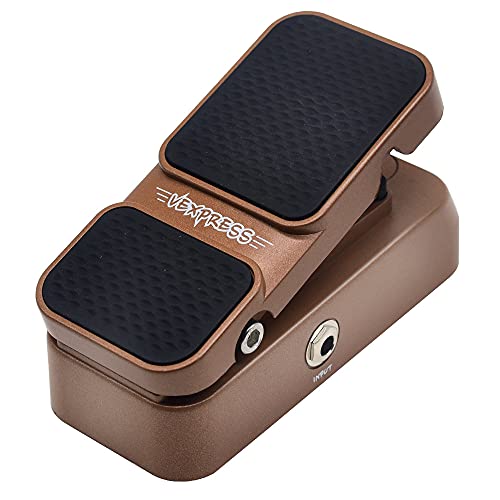
Brand: SONICAKE
Features: Passive Volume Control/Expression Control 2 in 1; Automatically Detects Functionality; Works with various instruments
Best for: Players seeking a compact, passive solution that can handle either volume or expression control on a small pedalboard.
Limitations: Functionality detection may vary with different setups; may require careful cabling to ensure consistent operation.
Volume (X) Mini Pedal — Jim Dunlop

Brand: Jim Dunlop
Features: MINI FOOTPRINT; Delivers smooth swells; Express your signal with real-time control; Tested to over one million cycles
Best for: Players who value a small travel-friendly footprint with pro-grade volume control and reliable performance for effects on stage or in the studio.
Limitations: Mini form factor may feel cramped for players with larger footwear or preference for a larger pedal surface.
Ernie Ball VP JR 25K Volume Pedal, For Active Signals

Brand: Ernie Ball
Features: Compact design; 25 VPJR potentiometer for active pickup signals; Tuner output
Best for: Players with active pickups seeking a compact control pedal that integrates with a tuner output for on-stage setup.
Limitations: Optimized for active signals; may not be ideal for purely passive guitars.
Buying Guide
What signal type are you controlling?
Passive guitar signals do not require power and are generally simpler to integrate with volume pedals. Active pickups may need pedals that handle higher signal levels without tone loss. Choose a pedal designed for your signal type to maintain tone integrity.
What pedalboard space do you have?
Compact pedals (like the VP JR or Volume (X) Mini) are ideal for small boards or travel setups. If you perform with a larger board or need a traditional feel, a full-size pedal may be preferred.
Do you want dual control (volume plus expression) in one unit?
Dual-function pedals like Lefiko’s and SONICAKE’s EXP option give streamlined control for volume and effect parameters. Ensure your effects chain and cables are compatible with TRS control for full functionality.
Are there any aesthetic or build considerations?
Limited edition finishes or premium build materials (such as Kevlar cords) can matter for stage presence and long-term durability. If you play in high-visibility environments, appearance may influence your choice.
What about reliability and long-term use?
Pedals that have been tested for millions of cycles offer confidence for frequent gigging. Consider durability, switch life, and the pedal’s compatibility with your current rig.
How should you test a pedal before buying?
If possible, audition the pedal with your guitar, amp, and effects chain. Listen for smooth, quiet operation during swells and ensure the taper or vibe matches your playing style. If testing is not possible online, rely on documented features and user experiences described in product outlines.
Quick reference: buying considerations at a glance
- Small boards: VP JR 250K or Volume (X) Mini Pedal
- Dual control desired: Lefiko or SONICAKE EXP Pedal
- Active vs passive: Active-oriented pedals like the 25K VP JR suit active pickups
- Durability and pro-grade use: Jim Dunlop Volume (X) Pedal
FAQ
- What is the difference between a volume pedal and an expression pedal?
Answer: A volume pedal solely controls signal level, while an expression pedal can modulate parameters on connected effects in real time. - Can I use a passive volume pedal with active pickups?
Answer: Yes, but ensure the pedal is suited for active signals and can handle the signal level without tone loss. - Is a dual-function pedal worth it for beginners?
Answer: It can simplify setups by combining two controls in one unit, but may add complexity in wiring and cable management. - Do volume pedals require power?
Answer: Most passive volume pedals do not require power; some dual-function or expression-capable pedals may rely on a TRS connection. - Which pedal is best for compact travel boards?
Answer: Compact options such as the VP JR 250K, 25K variants, or the Volume (X) Mini Pedal are well-suited for limited space. - Are there any compatibility concerns with different guitars or amps?
Answer: In general, most passive pedals work across standard guitar rigs, but check your guitar’s output level and your amp’s input to prevent unwanted tonal changes.