Answering the practical needs of players, this guide highlights five top jazz guitar books that cover chords, scales, improvisation, and classic standards. Each pick is chosen for specific goals—whether you’re a beginner seeking a solid method, a mid-level player aiming to expand vocabulary, or an advanced guitarist wanting comprehensive study. The following sections explain who each book best serves, with concise reasons and a practical caution where relevant. A quick buyer’s table is included to help you compare at a glance.
| Product | Best For | Why It Stands Out |
|---|---|---|
| Jazz Guitar Method – Learn Chords, Scales, Improvisation, and Soloing | Beginners to early-intermediate players | Structured step-by-step lessons with 40 jazz classics and online audio for practice. |
| First 50 Jazz Standards You Should Play on Guitar | Players building a core standard repertoire | Chord-melody arrangements with tabs, chords, and lyrics for 50 essential tunes. |
| Jazz Guitar, Complete Edition (Book & CD) | Comprehensive study with integrated audio | All-in-one edition covering technique and repertoire with online audio support. |
| Wolf Marshall’s Jazz Guitar Course: Mastering the Jazz Language | Advanced learners seeking extensive language development | Deep, language-based approach with hundreds of audio tracks for vocabulary building. |
| The Real Book Volume 1 Sixth Edition | Musicians preparing for real-band situations | Extensive fake book with 400 standards for performance-ready lead sheets. |
Jazz Guitar Method – Learn Chords, Scales, Improvisation

This Hal Leonard method book offers step-by-step instruction focused on chords, scales, improvisation, and soloing, complemented by 40 jazz classics. It is best for beginners to early-intermediate players who want a clear path from foundational theory to practical playing. The included online audio helps reinforce rhythm and phrasing, making it easier to internalize jazz conventions. A potential limitation is that it primarily targets foundational material; advanced players may want additional vocabulary beyond the included pieces.
First 50 Jazz Standards You Should Play on Guitar

Ideal for players building a core repertoire, this Hal Leonard book presents 50 standards with chord-melody arrangements, tabs, chords, and lyrics. It’s best for intermediate players who want practical, performance-ready material and a clear path to playing standards in a jam or duo setting. The arrangement density may be challenging for complete beginners. A note: while it emphasizes playability, it may not delve deeply into improvisational language beyond the arrangements.
Jazz Guitar, Complete Edition
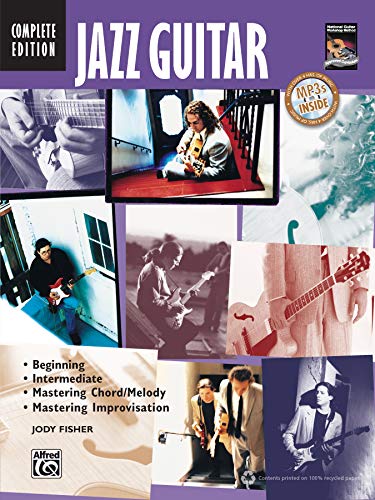
This edition from Alfred Music provides a comprehensive study with a book and online audio. It covers essential jazz guitar techniques and repertoire, making it suitable for dedicated learners who want a broad, cohesive program. It’s best for players who prefer a structured curriculum rather than scattered topics. A limitation to consider is that the CD/online audio scope may vary by update; ensure access to the latest online materials if you choose this route.
Wolf Marshall’s Jazz Guitar Course

Targeting serious students, this book from Hal Leonard emphasizes the jazz language with more than 600 audio tracks. It’s best for advanced learners who want a rich, language-focused approach to improvisation and rhythm. The depth and volume of material make it time-intensive; beginners may find the density overwhelming. Use this when you want to systematically build a large repertoire and fluency in idiomatic jazz vocabulary.
The Real Book Volume 1 Sixth Edition

Official jazz standards in a real-world fake book format, this Hal Leonard volume is essential for players who want practical lead sheets for live settings and ensembles. It is best for intermediate to advanced players who need a broad catalog of common standards. A caution: the Real Book sometimes contains variations in chord spellings or melodies across editions, so check your edition for consistency with your chart-reading practice.
Buying Guide: Key Purchase Considerations
- Skill level and goals: Choose a book that aligns with your current playing level and whether you want method-based learning, repertoire-building, or language immersion.
- Format and audio support: Books offering online audio or CDs can accelerate learning by providing authentic rhythm, articulation, and tempo references.
- Repertoire scope: If you aim to perform, consider books with standard tunes and practical lead sheets; for academic study, look for language-driven methods with concepts like ii-V-I and harmony approaches.
- Arrangement style: For those focusing on chords and melody, chord-melody compilations are helpful; for improvisation, seek books with extensive examples and play-along materials.
- Edition and compatibility: Real Book editions vary; ensure alignment with your performance context (C instruments vs. concert pitch) and prefer editions that match your instrument and notation preferences.
Frequently Asked Questions
- What is the best jazz guitar book for beginners?
Basic method books with guided chords and scales, plus audio, are ideal for beginners. - Do jazz guitar books include play-along tracks?
Yes, several editions include online audio or CDs to practice timing and phrasing. - Should I start with standards or a method book?
Starting with a method book helps build fundamentals; standards books are great after building basic skills. - Is the Real Book suitable for learning chord shapes?
It’s useful for repertoire and chart reading, but not a structured chord-by-chord method. - Are chord-melody books better for solo performance?
Yes, they provide arrangements that combine melody and harmony for solo guitar. - Can I rely on these books for improvisation practice?
Several titles emphasize improvisation language and scales; pick one that matches your level and goals.