Answering the search for a reliable mesh wifi router, these systems deliver strong whole-home coverage, smart device handling, and easy setup. Ideal for homes with multiple devices, streaming, gaming, or smart-home equipment. This guide highlights five top options and explains who each is best for, with practical buying notes.
| Product | Best For | Coverage | Notes |
|---|---|---|---|
| TP-Link Deco X55 AX3000 WiFi 6 Mesh System (3-Pack) | Mid-size homes, many devices | Up to 6500 sq ft | Wi‑Fi 6, strong device handling |
| Deco 7 Dual-Band BE5000 WiFi 7 Mesh System | Performance-focused homes | Up to 6600 sq ft | Wi‑Fi 7, 4‑stream BE5000 |
| TP-Link Deco S4 Mesh AC1900 (3-Pack) | Budget-friendly, simple setups | Up to 5500 sq ft | Mesh with single network name |
| NETGEAR Orbi 370 Series Mesh System | Homes needing WiFi 7 speeds | Up to 6000 sq ft | Robust performance across devices |
| TP-Link Deco XE75 AXE5400 Tri-Band WiFi 6E (3-Pack) | Future-proof, 6 GHz band | Up to 7200 sq ft | Wi‑Fi 6E, tri-band mesh |
TP-Link Deco X55 AX3000 WiFi 6 Mesh System, Deco X55(3-Pack)

The Deco X55 3-pack uses Wi-Fi 6 with AX3000 speeds to provide seamless whole-home coverage. It can connect many devices with stable performance, and is designed for homes up to 6500 square feet. This kit is best for households with multiple smartphones, laptops, streaming devices, and smart-home gadgets. The system is positioned as better than traditional range extenders for eliminating dead zones, with a focus on reliable connectivity across large spaces.
Best for: Larger homes or device-heavy environments where consistent coverage matters most. Choose this if you want a future-ready mesh that couples strong speed with broad coverage.
Caution: Real-world speeds depend on distance, walls, and interference. If your home has many thick walls, plan for a larger 3-pack deployment or additional nodes.
Deco 7 Dual-Band BE5000 WiFi 7 Mesh System

The Deco 7 BE5000 is a Wi-Fi 7 mesh system with 4-stream backhaul capabilities and a broad coverage area measured at up to 6,600 square feet. It supports over 150 devices and is designed for households seeking high throughput for 4K/8K streaming, gaming, and AR/VR experiences. The backhaul can balance traffic to keep multiple devices performing well. This is a strong pick for power users or busy families that need steady performance across many connected devices.
Best for: Power users who want robust performance, numerous devices, and future-forward Wi-Fi 7 features in a scalable setup.
Caution: Real-world performance varies, and multi-unit setups require careful placement to optimize backhaul paths.
TP-Link Deco S4 Mesh AC1900 (3-Pack)
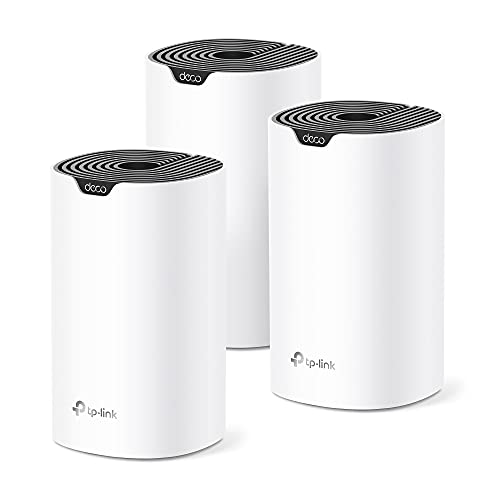
The Deco S4 3-pack delivers a practical mesh solution with a single network name for easy roaming. It covers up to 5,500 square feet, suitable for mid-sized homes with standard-to-moderate device loads. It’s a cost-conscious option that avoids the complexity of multiple network SSIDs while still providing stable coverage and reliable mesh handoffs between units.
Best for: Budget-conscious buyers who want a simple, reliable mesh network without extra bells and whistles. Good for standard households with several streaming devices.
Caution: Performance may be limited compared to tri-band or Wi‑Fi 6E systems in very dense device environments.
NETGEAR Orbi 370 Series Mesh System

The Orbi 370 Series provides whole-home coverage up to 6,000 square feet and supports up to 70 devices on a single network. It uses dual-band backhaul and claims next-generation Wi-Fi 7 speeds up to 5 Gbps for streaming, gaming, and video calls. Real-world results depend on device mix and internet plan. It’s well-suited for larger homes with high device counts seeking strong nationwide-brand support.
Best for: Homes needing broad coverage with high device capacity and strong backhaul performance, especially in multi-floor layouts.
Caution: The speed benefits are contingent on appropriate placement and compatible internet service.
TP-Link Deco XE75 AXE5400 Tri-Band WiFi 6E System

The Deco XE75 3-pack introduces WiFi 6E with a dedicated 6 GHz band, offering tri-band performance and coverage up to 7,200 square feet. It’s designed for homes with many devices and high-bandwidth demands, including 8K streaming and VR. The 6 GHz band helps reduce interference from older networks, providing a more stable experience in crowded environments.
Best for: Early adopters and power users who want the latest 6E technology for future-proofing and maximum throughput in busy homes.
Caution: 6E devices are needed to fully leverage the 6 GHz band; legacy devices may not benefit directly.
Buying Guide
What should you consider when choosing a mesh wifi system?
- Coverage area: Match the system’s square footage capability to your home’s size and floor plan. Large or multi-story homes benefit from 3-pack or more nodes.
- Speed and technology: Wi‑Fi 6/6E offers better device capacity and future-proofing. For many households, AX3000 is a balanced baseline; Wi‑Fi 7 or 6E is ideal for heavy loads.
- Backhaul and performance: Some systems use wireless backhaul, others support wired backhaul. Reliable backhaul improves overall stability, especially with many devices.
- Device count: If you have many smart devices, look for systems that claim high device support without congestion.
- Ease of use: Look for simple setup, app-based management, and straightforward guest networks or parental controls.
- Future-proofing: 6E and Wi‑Fi 7 options offer longer relevance as new devices emerge.
FAQ
- What is a mesh wifi system?
It uses multiple nodes to blanket your home in wifi, reducing dead zones and enabling seamless roaming between units. - Do I need Wi‑Fi 6E or Wi‑Fi 7?
Wi‑Fi 6E and 7 offer higher capacity and faster speeds for busy homes, but may be more expensive and require compatible devices. - Will a 3-pack cover my home?
Most 3-pack kits cover typical mid-size homes; larger layouts or multi-floor homes may need additional nodes. - Is wired backhaul better than wireless?
Yes, wired backhaul can improve stability and throughput, especially in dense wireless environments. - Can I mix different brands?
Best results come from using nodes within the same mesh system; cross-brand compatibility varies. - Do these systems support smart-home hubs?
Yes, modern mesh systems generally support common smart-home ecosystems and devices.