Answering the buyer’s search: a mesh wifi system can deliver seamless, high-speed coverage across large homes by using multiple nodes. This guide highlights five solid options suitable for a variety of needs, from budget-friendly setups to high-capacity networks. Best for families with multiple devices, home offices, or multi-level layouts, these systems aim to reduce dead zones and buffering. The following picks are organized to help you compare coverage, backhaul capabilities, and device capacity at a glance. A quickBuying table summarizes core attributes to consider as you decide.
| Product | Estimated Coverage | Best For |
|---|---|---|
| TP-Link Deco X55 (3-Pack) | Up to 6,500 sq ft | Large homes with many devices |
| Deco S4 (3-Pack) | Up to 5,500 sq ft | Budget-friendly whole-home wifi |
| TP-Link Deco XE75 (3-Pack) | Up to 7,200 sq ft | WiFi 6E for future proofing |
| eero 7 (3-Pack) | Up to 6,000 sq ft | Affordable WiFi 7 basics |
| NETGEAR Orbi 370 Series (3-Pack) | Up to 6,000 sq ft | Reliable WiFi 7 performance |
TP-Link Deco X55 AX3000 WiFi 6 Mesh System

The Deco X55 is a Wi-Fi 6 mesh system designed to eliminate dead zones with AX3000 speeds and wide coverage. It supports up to 150 connected devices across the mesh and claims seamless performance across a 6,500 sq ft area. The 3-pack setup is well-suited for large homes with multiple floors and many smart devices. Best for households that want strong performance now and simple expansion later. Limitation: performance varies by device distance and obstacles like walls or dense furniture.
Deco 7 Dual-Band BE5000 WiFi 7 Mesh System

Deco 7 BE5000 is a WiFi 7 mesh solution designed to handle high-bandwidth tasks with 4 streams and a strong backhaul, covering up to 6,600 sq ft for more than 150 devices. Best for power users who want robust performance and future-ready capabilities. Choose this if you have many smart devices and want multi-device optimization. Caution: backhaul performance depends on unit placement and network conditions.
TP-Link Deco S4 Mesh AC1900 WiFi System
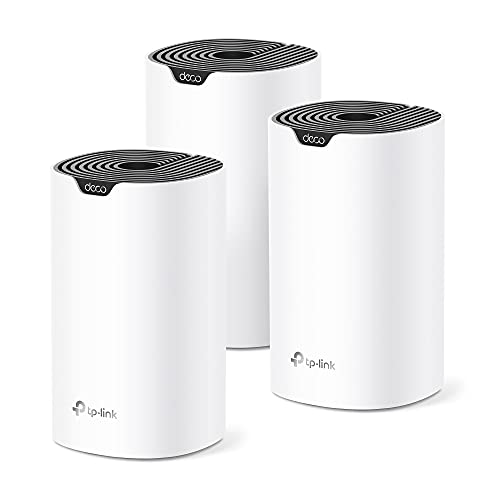
The Deco S4 trio offers a budget-friendly mesh solution with reliable AC1900 speeds and seamless roaming with a single network name. It’s best for mid-sized homes up to 5,500 sq ft and households seeking easier setup without sacrificing essential mesh benefits. The system can be a good fit for first-time mesh buyers or those prioritizing cost-effectiveness. Limitation: top-end throughput is lower than newer Wi-Fi 6/6E models, which may matter for high-demand gaming or 4K streaming in dense environments.
eero 7 Dual-Band Mesh Wi-Fi 7 Router (3-Pack)

eero 7 provides an affordable entry into Wi-Fi 7 with dual-band configuration for supporting up to 2.5 Gbps internet plans and a total free coverage of about 6,000 sq ft. Best for households prioritizing easy setup, consistent roaming, and straightforward management via the eero app. Limitation: dual-band configuration may not maximize peak performance in ultra-high-bandwidth scenarios compared with tri-band or Wi-Fi 7 systems.
NETGEAR Orbi 370 Series WiFi 7 Mesh System

The Orbi 370 Series offers a robust WiFi 7 mesh solution with a 6,000 sq ft coverage claim and support for up to 70 devices on one network. It emphasizes high-speed backhaul and broad compatibility for streaming, gaming, and smart-home devices. Best for users who want a proven, scalable mesh that performs well across multiple devices. Limitation: real-world speeds depend heavily on home layout and internet plan capabilities.
Buying Guide
- Coverage area: Match the system to your home’s square footage. Larger homes benefit from 3-pack or higher-capacity options, with backhaul considerations for multi-story layouts.
- Wi-Fi standard: Wi-Fi 6/6E and Wi-Fi 7 offerings provide future-proof performance, more device support, and less congestion in dense environments.
- Device density: If many smart devices share the network, choose systems that advertise higher concurrent device support and robust backhaul options.
- Backhaul type: Tri-band or 6 GHz backhauls can improve performance in busy homes. Consider whether wired backhaul is available and beneficial.
- Ease of setup and management: Apps that simplify setup, parental controls, and guest networks are important for non-technical users.
- Future-proofing: For long-term value, prioritize newer standards (Wi-Fi 6E/7) and scalable systems that allow adding nodes without losing performance.
- Limitations to watch: Real-world speeds depend on distance, walls, interference, and ISP plan. A higher-end system may not dramatically beat a mid-range system in all homes.
FAQ
- What is a mesh wifi system? A network that uses multiple nodes to blanket a home with wifi, reducing dead zones and maintaining consistent speeds.
- Do I need Wi-Fi 6/6E or Wi-Fi 7 for my home? It depends on your devices and internet plan. Wi-Fi 6/6E and 7 offer better performance, especially in dense device environments and higher-speed plans.
- How many nodes do I need? For most homes, 3 nodes are enough, but larger or multi-story houses may require more or higher-capacity systems.
- Can I mix brands? Mixing is generally not recommended for best performance; use a single mesh ecosystem where possible.
- Is wired backhaul better? Yes, wired backhaul often yields more stable speeds and reduces wireless backhaul congestion.
- Will these systems replace my router? Many act as a primary router, while others function as modules that work with existing gateways. Check the product’s compatibility.