The best network cable tester selection depends on your needs: quick fault detection, long-distance length measurement, or multi-purpose testing for home and professional setups. This guide highlights five top options, clarifying who each is best for and why. Use the quick summary table to compare at a glance.
| Product | Best For | Key Benefit | Limitations |
|---|---|---|---|
| Klein Tools VDV501-851 Cable Tester Kit | Pro technicians needing broad cable support | Tests voice, data, coax; long cable measurement | Not PoE testing |
| Klein Tools VDV526-200 LAN Scout Jr | Field techs focusing on LAN wiring | Large backlit display; comprehensive fault detection | Limited to RJ45 and patch cords |
| TESMEN TLP-123A Network Cable Tester | DIY to small office setups | RJ11/RJ45 support; one-button operation | Feature set is basic relative to pro kits |
| Klein Tools VDV526-100 | Users needing quick, single-button testing | Single-button testing; supports multiple cable types | Less feature depth than larger kits |
| FNIRSI LPM-10A | Heavy-duty testing with port tracing | Cable tracing; POE and multi-function tests | Interface may be less intuitive for beginners |
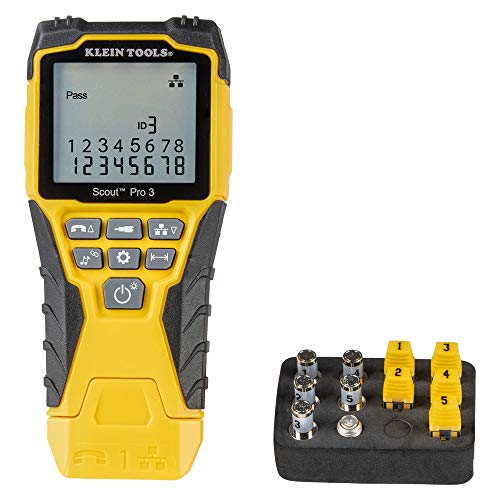
Klein Tools VDV501-851 Cable Tester Kit
This versatile tester handles voice (RJ11/12), data (RJ45), and coax video cables. It provides clear results for unenergized Ethernet runs and can measure cable length up to 2000 feet (610 m). It detects Open, Short, Miswire, and Split-Pair faults for thorough fault localization. Best for professional installers who need broad cable type support and long-distance measurement. Note that PoE testing is not supported.
Klein Tools VDV526-200 LAN Scout Jr

Designed for data cables and patch cords, the LAN Scout Jr focuses on RJ45 testing with a large backlit LCD that simplifies results in dim environments. It supports fault detection for Open, Short, Miswire, Split-Pair, Cross-over, and Shield. Best for field techs who need a readable display and reliable data-line testing on site. Choose this if you frequently work in low-light conditions and with Ethernet runs up to standard LAN categories.
TESMEN TLP-123A Network Cable Tester

The TESMEN TLP-123A is a multifunction tester supporting RJ45 and RJ11 with quick line-connectivity checks and LED indicators. It’s compact and portable, with one-button operation and a test speed adjustment for flexibility. It’s best for small offices or home labs where a simple, reliable tester is preferred. Limitation: fewer advanced features compared to full professional kits.
Klein Tools VDV526-100 Explorer

The VDV526-100 Explorer offers single-button testing for voice and data cables, supporting CAT3, CAT5e, and CAT6/6A. It provides fast LED status, including Pass, Miswire, Open-Fault, Short-Fault, and Shield. Best for contractors who want quick verification without loading extra features. A limitation is that it may not cover all advanced testing scenarios found in larger kits.
NOYAFA NF-8518 Network Cable Tester

The NOYAFA NF-8518 combines nine core functions, including cable continuity, scanning, port flashing, length measurement, POE testing, and an integrated optical power meter for fiber. It supports detecting PoE polarity and voltage, making it suitable for mixed networks with fiber components. Best for IT professionals who manage complex networks. Note that the fiber-related connectors may require separate adapters.
Buying Guide: Network Cable Tester Essentials
What should you look for when choosing a network cable tester?
- Cable type support: Ensure the tester covers RJ11, RJ12, RJ45, coax, and any fiber-related needs if you require cross-compatibility.
- Fault detection: Look for Open, Short, Miswire, Split-Pair, and Shield tests. Some kits also include Cross-over and Shield fault checks.
- Length measurement: If you work with long runs, select a model with extended length measurement (thousands of feet or meters).
- Display and usability: A large backlit LCD or bright LED indicators reduce errors in low-light work sites.
- Portability: Compact, durable housings with simple one-button tests are ideal for field use.
- POE capability: For networks with powered devices, verify whether PoE testing is supported and reliable.
- Fiber support: If your network includes fiber, consider devices with optical power meters or fiber test features, noting any required adapters.
How to choose by scenario
- Pro field technician: Choose a model with broad cable type support and long-range measurements, such as the Klein Tools VDV501-851.
- LAN installation specialist: A unit with a large, clear display and fast fault indication, like the LAN Scout Jr, is advantageous.
- Home network DIYer: A compact tester with RJ11/RJ45 support and easy operation, such as TESMEN TLP-123A, fits well.
- Mixed environment with fiber: Look for devices that offer optical power meters and POE testing capabilities, such as the NOYAFA NF-8518.
FAQ
- What is a network cable tester used for? It checks continuity, detects faults, and maps pin connections for Ethernet, telephone, and video cables.
- Do all testers test PoE? No. Some testers test PoE, while others do not. Check specifications before purchase.
- Can testers identify miswiring? Yes. Most models detect miswired or split-pair conditions.
- Should I buy a tester with a backlit display? Yes, especially for work in dim environments or on-site installations.
- Is fiber testing common in Ethernet testers? Some advanced units include fiber-related measurements or meters; others require separate adapters or devices.
- What’s a practical selector rule? Start with RJ45/RJ11 support and a clear fault-detection set; add length measurement if long cable runs are typical in your work.