Need a reliable pitch shifter pedal to expand your sonic palette? This guide highlights five standout options, each suited to different players—from live performers needing quick detunes to studio-minded musicians chasing rich harmonies. Below you’ll find who each pedal is best for, why it was selected, and practical buying tips to help you compare features quickly.
| Product | Best For | Why It Stands Out |
|---|---|---|
| LEKATO Mini Pitch Shifter Pedal | Players seeking flexible harmonizing and detune options | Three modes including harmony up to 2 octaves and 16 customizable parameters |
| Digitech DROP Compact Polyphonic Drop Tune Pitch Shifter | Live performers needing reliable downward pitch shifts | Polyphonic drop with preset steps and true bypass |
| DigiTech DROP Compact Polyphonic Drop Tune Pitch-Shifter | Versatile tuning shifts for studio and stage | 1 semitone to octave down with momentary or latch modes |
| Donner Octave Guitar Pedal | Budget-friendly multi-shift options | 7 shift types and 3 tone modes for wide tonal variation |
| Electro-Harmonix Pitch Fork | Studio-quality polyphonic pitch shifting | Three shift modes with an expansive 11-position transposition control |
LEKATO Mini Pitch Shifter Pedal
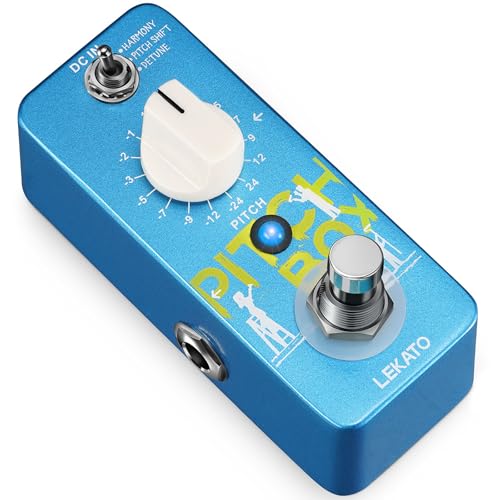
The LEKATO Mini Pitch Shifter Pedal is designed for players who want compact versatility in a small footprint. It offers three flexible modes—Harmony, Pitch Shift, and Detune—allowing quick tonal shifts and layered textures. The Harmony mode can raise or lower tones by two octaves for rich, stacked harmonies, while Pitch Shift provides a fully wet output ideal for precise detuning or tuning adjustments in live or studio contexts. Detune adds subtle, textured variations to your signal, useful for warble-like effects. This pedal is well suited for players seeking a compact solution with multiple creative options in one box.
Best for: guitarists who want a small, all-purpose harmonizer with real-time polyphonic capabilities and a robust set of customizable parameters. The 16 adjustable parameters give you ample room to tailor the effect to your rig and musical style. Caution: the compact design may require thoughtful pedalboard planning to ensure ease of use during performances, especially when dialing in multiple parameters.
Digitech DROP Compact Polyphonic Drop Tune Pitch Shift Pedal

This Digitech DROP pedal focuses on downward pitch shifting with a polyphonic approach, making it ideal for players who frequently drop tunings or need octave-down sounds. It features 1-7 semitone downward shifts via preset foot settings, preserving the original tone when bypassed thanks to true-by-pass switching. An additional benefit is the two extra settings for octave-down shifts with or without the dry signal, enabling flexible blending of dry and processed tones. This pedal is best for players who value reliable, on-the-fly drop tuning without compromising signal integrity.
Best for: performers who rely on rapid, reliable drop tunings during live sets or studio sessions. Consider this option if you want straightforward, dependable pitch-down shifts with minimal tonal coloration when switched off. Limitation: the primary focus is downward shifts; upward or complex harmonies are not the central feature.
DigiTech DROP Compact Polyphonic Drop Tune Pitch-Shifter

The DigiTech DROP is another compact drop-tuning solution that emphasizes versatility through its polyphonic capability and a broad downward pitch range. It supports shifting from 1 semitone to an octave down, with either momentary or latching mode for the footswitch. The True Bypass design ensures your instrument’s core tone remains intact when the effect is not in use. Best for: guitarists who need a simple, reliable drop-down shift without extra modulation or harmonizing. Caution: the device focuses on downward shifts; for expanded harmonization, you may want a dedicated harmony pedal in addition to this unit.
Donner Octave Guitar Pedal

The Donner Octave Guitar Pedal presents a 7-shift type system with 3 tone modes (Sharp, Flat, and Detune) to cover a broad range of pitch-shifting moods. The Sharp mode raises pitch, Detune introduces a small, adjustable shift, and Flat lowers pitch. This preset approach makes it accessible for players who want immediate tonal options without deep parameter tweaking. Wet and dry controls allow you to balance the processed signal with the original sound, helping you fit the effect into your overall mix. Best for: budget-conscious players who want a versatile octave and semitone shifting solution. Limitation: fewer subtlety options than high-end multiplatform units, which may matter for studio detail work.
Electro-Harmonix Pitch Fork

The Electro-Harmonix Pitch Fork is a classic choice for players seeking polyphonic pitch shifting with a broad range of control. It offers three shift modes (up, down, or dual) and an 11-position Shift knob to dial in precise transposition intervals. An EXP input provides an external expression pedal for real-time pitch control, enabling expressive playing in live settings. This pedal is best for players who want a flexible, studio-ready tool that can be integrated with other modulators. Caution: it may require more careful setup to dial in clean blending with dry signals in complex rigs.
Buying Guide: How to Choose a Pitch Shifter Pedal
- What range do you need? If you want up to two octaves of harmony, look for pedals with ±2 octave capability.
- Do you prefer polyphonic or monophonic operation? Polyphonic units handle chords better; monophonic are simpler but may struggle with complex passages.
- How important is true bypass? True bypass helps preserve your core tone when the pedal is off; this matters in live and studio contexts.
- What range of shifts will you use most? Some pedals excel at down-tuning; others offer robust harmonizing or detune features.
- Is an external expression pedal important? If you want real-time control of pitch, an EXP input adds expressive flexibility.
- How much board space and budget do you have? Compact pedals save space, but feature sets vary widely across price points.
FAQ
- What is a pitch shifter pedal good for? It alters the pitch of your instrument up or down, enabling harmonies, detuning, or drop tunings to expand sonic textures.
- Do these pedals work with bass guitars? Yes, most models are designed to accommodate guitar and bass signals, but check the minimum frequency handling for your bass range.
- What does polyphonic mean in pitch shifting? Polyphonic means the pedal can shift multiple notes simultaneously, preserving chords and textures better than monophonic units.
- Is true bypass important for live use? Yes, it helps keep your core signal intact when the effect is bypassed, reducing tone loss between pedals.
- Can I use an expression pedal with these pedals? Some models offer an EXP input for dynamic pitch control; this is great for sweeping changes during performance.
- Will these pedals alter tone when bypassed? True bypass pedals minimize tone coloration when off, but some digital models may still introduce minor discrepancies depending on circuitry.