Best plug-in timers let you automate lights, lamps, seasonal decor, and small appliances without internet access or apps. This guide highlights five reliable options ideal for different needs—from compact indoor timers to heavy-duty outdoor models. Whether you want simple daily schedules or more configurable settings, these timers are chosen for ease of use, reliability, and clear, objective comparison.
BN-LINK BND-60/U47 Indoor Mini 24-Hour Mechanical Timer

The BN-LINK BND-60/U47 is a compact 3-prong mechanical timer designed for indoor use. It supports up to 24 on/off settings per day, with settings repeating automatically after being plugged in. Pins UP indicate OFF, pins DOWN indicate ON, making setup straightforward even for first-time users. Best for small lamps or appliances in living spaces or offices where a simple daily schedule suffices.
Who it’s best for: This model suits budget-minded buyers seeking a compact, easy-to-program timer for indoor lighting or small devices. Why selected: Its built-in pin dial eliminates loose parts and provides a reliable daily cycle without apps. Limitation: New users may need to remember that pins are initially DOWN when opened.
TiFFCOFiO Indoor Mechanical Outlet Timer (2 Pack)

The TiFFCOFiO 3-prong timer offers 48 ON/OFF options in a 24-hour cycle, with each pin representing a 30-minute interval. This 2-pack is compact and places the outlets underneath to save space. It’s suitable for automating devices like lamps, fans, or seasonal lighting with a straightforward daily repeat pattern.
Who it’s best for: Homeowners needing two timers to cover separate rooms or devices. Why selected: High interval granularity (30 minutes) and space-saving design. Caution: Mechanical timers rely on manual pin settings and may require periodic verification of pins for accuracy.
GE 24‑Hour Mechanical Outlet Timer Switch (2 Pack)

The GE 46211 two-pack provides simple daily automation with day-long on/off cycles. It uses 30-minute pushpins for quick setup and does not require Wi-Fi or apps. Dual grounded outlets let you control two three-prong devices from a single indoor receptacle, making it convenient for lamps and decor.
Who it’s best for: Users who want a dependable, app-free solution with two outlets per timer. Why selected: Clear 30-minute increments and two outlets per unit simplify multi-device schedules. Limitation: Mechanical design means manual setup and no remote control capabilities.
HBN Indoor Mini 24-Hour Mechanical Timer

The HBN timer is a compact indoor option with 3-prong compatibility and a 24-hour cycle. It uses 30-minute intervals and repeats daily. It’s designed to automate lamps, appliances, and holiday lighting in living spaces or offices where compact form and ease of use are priorities.
Who it’s best for: Buyers seeking a straightforward indoor timer with a small footprint. Why selected: Clear pin-based programming and repeating daily schedule. Limitation: Pins may be pressed down in the box; users should verify OFF/ON orientation during setup.
BN-LINK 24 Hour Plug-in Mechanical Timer Grounded (1 Pack)

This BN-LINK model emphasizes no loose parts with a built-in pin dial, letting you press pins down for ON and keep them up for OFF. It’s ideal for controlling devices like fans, lights, grow lights, or aquarium equipment. The timer is suited for energy savings and routine automation in indoor spaces.
Who it’s best for: People who want a reliable, no-frills mechanical timer for multiple small appliances. Why selected: Integrated dial reduces potential pin loss. Caution: For certain high-load devices, verify the outlet’s current rating and usage limits.
GE 24‑Hour Mechanical Outlet Timer Switch (1 Pack)
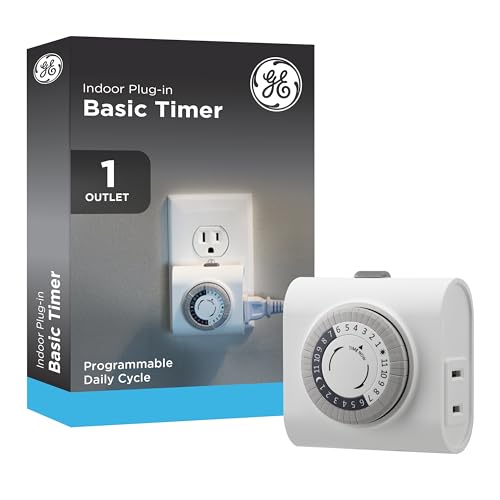
GE’s single-pack 24-hour timer uses a simple pushpin interface with 30-minute increments, designed for indoor lighting, small appliances, and seasonal décor. It converts a single outlet into a timed outlet for basic automation and security benefits through consistent schedules.
Who it’s best for: Individuals needing a straightforward, budget-friendly single outlet timer. Why selected: Clear mechanical controls and ETL listing for indoor use. Limitation: Only one outlet per timer means extra units for multi-device setups.
Buying Guide
- What environment will the timer be used in? Indoor versus outdoor timers require weather resistance and different build quality. Choose models labeled for indoor use unless you need outdoor suitability.
- What scheduling granularity do you need? If you want half-hour precision, pick timers with 30-minute pushpins or 30-minute interval pins. For simpler needs, a 60-minute interval may suffice.
- How many devices will you automate? If you need to control multiple devices, consider timers with two outlets or multi-pack options to reduce clutter and simplify setup.
- Do you prefer mechanical (no Wi-Fi) or smart (app-based) control? Mechanical timers are reliable offline but lack remote control; smart timers offer remote scheduling and voice assistant compatibility.
- What load can the timer handle? Check the current rating (amps) to ensure compatibility with lamps, fans, or small appliances. Avoid high-wattage devices on low-capacity timers.
- Is pin placement intuitive for you? Timers with clearly labeled ON/OFF pins help prevent misconfiguration, especially when room lighting changes seasonally.
FAQ
- Do plug-in timers require a Wi-Fi connection? No. Mechanical timers operate without Wi-Fi or apps, relying on physical pins or dials.
- Can I use a plug-in timer for outdoor lights? Some timers are designed for outdoor use; always verify weather resistance and listing (CSA, ETL, IP rating) before outdoor deployment.
- How precise are the intervals on these timers? Most offer 30-minute intervals, providing reliable half-hour increments for daily schedules.
- Will a timer save energy automatically? Timers help reduce energy use by turning devices off when not needed, especially for lights and holiday decor.
- Can I program multiple timers to work together? Yes, you can set several timers to run devices in tandem, but ensure outlets and cords are arranged safely to avoid clutter.
- What is the best timer for beginners? A compact indoor timer with straightforward pin dialing is typically easiest for first-time users.