If you want true rear surround sound, these rear surround speakers deliver immersive audio from the back of the room. They are best for small-to-mid rooms, home theater enthusiasts upgrading from basic TV speakers, or system builders seeking targeted rear-channel performance. This guide highlights five solid options with clear, reference-friendly details to help you compare quickly and choose with confidence.
| Product | Best For | Key Benefit |
|---|---|---|
| Saiyin Indoor Wall Mount Passive Speakers | Compact spaces | Passive design with wall-mount suitability and natural mid/high range clarity |
| Polk Audio Signature Elite ES10 | Balanced, cinematic staples | High-sensitivity drivers for enveloping sound with strong bass |
| Polk Audio OWM3 Compact Wall & Bookshelf | Flexible placement | Seven placement orientations for diverse room setups |
| Klipsch R-41SA | Detail and clarity | Tractrix horn and LTS tweeter for precise high frequencies |
| Fluance SXBP2 Elite Bipolar Surrounds | Wide dispersion imaging | Bipolar design for immersive, wide surround field |
Saiyin Indoor Wall Mount Passive Speakers

These Saiyin rear surround speakers are compact passive units designed for use with a receiver or amplifier. They feature a 6-ohm impedance and a dome tweeter to deliver clearer midrange and higher frequencies. They are wall-mount friendly, making them suitable as rear channels in smaller rooms or compact home theaters. A key caveat is wiring: they are wired and do not include speaker wires or Bluetooth. Best for budget-conscious setups where mounting flexibility matters and a powered speaker is not required.
Best for: small rooms or retrofit projects where space is limited and you already own a compatible amp or AV receiver. This model is chosen for rear-channel duties due to its compact size and responsive mids/highs that help anchor immersive effects without overpowering the front soundstage.
Caution: These are passive speakers; you must supply appropriate speaker wire and a compatible amplifier/receiver. No wireless option is included, so plan cable routing accordingly.
Polk Signature Elite ES10 Surround Speakers

The Polk ES10 is a compact bookshelf pair designed as surround speakers that pair well with Dolby Atmos or standard 5.1 systems. It uses a 1″ tweeter and a 4″ woofer with Polk’s Power Port for enhanced bass. The ES10 is versatile with high sensitivity and impedance options, making it compatible with a broad range of receivers. Best for: listeners who want cinematic surround with clear high end and punchy bass without needing large towers. Limitations: as bookshelf-format, they may require stands or proper wall mounting for optimal rear placement.
Polk Audio T15 100 Watt Bookshelf Speakers

Polk’s T15 bookshelf speakers are a cost-effective choice for rear-channel duty in a budget system. They feature a 0.75″ tweeter and a 5.25″ Dynamic Balance driver for clear vocals and robust bass, with a design that allows wall mounting or stand placement. Best for: beginners building a 5.1 system on a tight budget, or as rear surrounds where space is at a premium. Caution: while suitable for rears, they may lack the refined imaging of higher-end models in larger rooms.
Klipsch R-41SA Surround Speakers
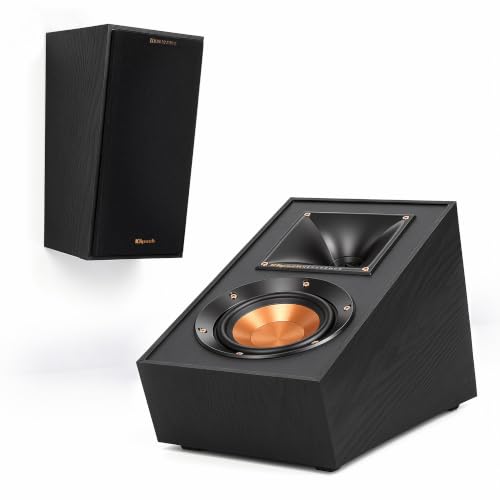
Klipsch R-41SA surround speakers provide a step up in detail with a Tractrix horn and LTS aluminum tweeter. These Dolby Atmos-enabled speakers can pair with or act as surrounds in compact systems, offering a broad, directed soundstage with less distortion at higher volumes. Best for: home theaters seeking precise, lively upper frequencies and a dynamic listening experience from rear channels. Limitation: some users may prefer a smaller footprint when room placement is constrained.
Fluance Elite Bipolar Surrounds SXBP2

Fluance SXBP2 bipolar surround speakers deliver wide dispersion for a highly immersive rear soundfield. The bipolar design distributes sound broadly, helping fill a room with more even rear-channel audio. They pair well with Fluance SX series and other compatible systems for a cohesive surround panorama. Best for: rooms where rear imaging benefits from broad, enveloping sound rather than a pinpoint source. Caution: bipolar cabinets require careful placement to avoid excessive crossover reflections in small rooms.
Buying Guide: Key Purchase Considerations
What should you consider before buying rear surround speakers?
- Room size and layout: Smaller spaces benefit from compact, wall-mountable models; larger rooms can handle larger bookshelf or floorstanding rears.
- Speaker type: Passive vs. powered. Passive requires a receiver/amplifier; powered offers easier integration but may limit placement.
- Dispersion pattern: Bipolar surrounds provide wide imaging; direct-radiating models offer more focused rear cues.
- Mounting options: Wall-mount vs. shelf or stand placement; ensure compatible mounting hardware and room clearance.
- Compatibility: Ensure impedance and power handling match your AV receiver. For Dolby Atmos/DTS:X setups, consider how surrounds integrate with up-firing or height channels.
- Front-rear balance: Choose speakers whose tonal character blends with your front speakers to avoid a mismatch in timbre.
How to position rear surrounds for best effect?
Place rear surrounds behind or to the sides of the listening position, slightly above ear level. Aim for even coverage and avoid direct beams toward the listener. If possible, use wall mounts to optimize toe-in and vertical alignment for consistent imaging.
Common trade-offs to weigh
- Size vs. bass output: Smaller satellites are easy to place but may require a subwoofer for deep bass extension.
- Wired vs. wireless: Wired provides stable, low-latency audio but requires wiring through walls; wireless adds flexibility but potential latency or interference.
- Budget vs. fidelity: Higher-end models deliver more precise imaging and dynamic range but at a higher cost.
FAQ
- What is the difference between bipolar and direct-radiating surrounds?
– Bipolar surrounds emit sound from two opposite sides for wide, enveloping imaging, while direct-radiating surrounds emit primarily from one side for more localized rear cues. - Do rear surrounds need to be expensive?
– Not necessarily. For many rooms, well-matched, budget-friendly models provide solid immersion, especially when paired with capable front speakers. - Should rear surrounds be wall-mounted?
– Wall mounting helps optimize dispersion and minimize room reflections. However, some setups work with bookshelf placement on stands or shelves if mounting is impractical. - Can passive surrounds work with any receiver?
– Passive surrounds require an appropriate power amp or AV receiver with speaker terminals and suitable impedance handling. Check your receiver’s supported impedance. - How important is matching timbre with front speakers?
– Matching timbre improves seamless integration and avoids jarring transitions between front and rear channels. - Is it better to place surrounds high or at ear level?
– Generally, surrounds are placed slightly above ear level to create a more immersive ambient effect, but room geometry may adjust this rule.