Answering the needs of homeowners seeking reliable, scalable solar energy, this guide highlights five residential-ready solar options. Each product is evaluated for home use, reliability, and the specific buyer it serves best. The list includes complete off-grid kits and high-efficiency panels suitable for rooftop installations, RVs, or off-grid cabins. Below, a quick summary table helps you compare key specs at a glance.
| Product | Type | PV Capacity (W) | Best For |
|---|---|---|---|
| ECO-WORTHY 10000W Off-Grid Kit | Complete Kit | 10620 | Homes seeking a full, integrated power system with large storage |
| ECO-WORTHY 10kW All-In-One Kit | Complete Kit | 10620 | Homes needing scalable, multi-room reliability with split-phase output |
| Callsun 450W Bifacial 2-Pack | Panel Pair | 900 | Rooftops seeking higher energy yield per panel in open areas |
| Callsun N-Type 400W Bifacial | Panel | 400 | Compact installations needing efficiency and anti-shading design |
| DOKIO 800W Panel Set | Panel Pair | 800 | Smaller off-grid systems or supplementary home charging setups |
ECO-WORTHY 10000W Off-Grid Solar Panel Kit

This all-in-one system delivers up to 10 kW of continuous power with 120V/240V split-phase support, suitable for running common home appliances. It includes five 590W solar panels (total 2,950W PV), generating up to 11.8 kWh daily under optimal conditions, plus a 48V 314Ah LiFePO4 battery offering 16.1 kWh storage. The package includes necessary cables for straightforward setup. Best for buyers seeking a turnkey off-grid solution with substantial storage and full-system integration.
Who this is best for: households wanting a scalable, self-contained grid-tied-like experience with robust energy storage and a relatively high daily energy yield. Cautions: real-world daily output depends on sun, installation angle, and location. Parallel-capable for expansion, up to 15 batteries in parallel.
ECO-WORTHY 10000W Output Complete Off-Grid Solar Panel Kit (10620W PV)

This higher-capacity alternative mirrors the first kit with an expanded PV capacity (18 × 590W panels) and two 48V 314Ah batteries, totaling 32.2 kWh. The 10kW inverter supports 120V or 240V split-phase output, with dual MPPT controllers and WiFi monitoring. Best for larger homes or properties requiring robust daytime generation and extensive energy storage with future expansion potential.
Who this is best for: larger households or off-grid setups that require significant energy storage and growth potential. Cautions: footprint and system complexity increase with scale; ensure adequate space and proper wiring for parallel operation.
Callsun 450W Bifacial Solar Panel 2-Pack

Featuring high-power N-Type 16BB cells and bifacial design, this 450W pair offers enhanced energy yield by drawing light from both sides. The dual-module parallel anti-shade design minimizes shading losses, helping maintain stable output in real-world conditions. Best for rooftops with open sightlines and reflective surroundings that boost rear-side energy capture.
Best for: homeowners wanting higher system efficiency per panel and better shading tolerance. Cautions: bifacial benefits are location-dependent; rear-side exposure and mounting conditions influence gains.
Callsun N-Type 16BB 400W Bifacial Panel

This 400W bifacial panel uses N-Type 16BB cells to deliver high efficiency (up to 25.6%) with improved shading resilience. The twin-cell parallel anti-shade design mirrors enhanced performance even when partial shading occurs. Durable build supports outdoor installation for rooftops, caravans, or off-grid setups.
Best for: compact, high-efficiency installations where shading is a concern and space is limited. Cautions: real gains depend on rear-side light availability and mounting orientation.
DOKIO 800W Panel Set (Two 400W Panels)
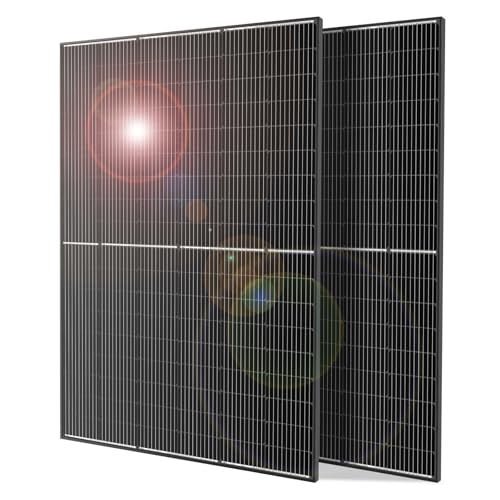
Two 400W panels deliver 800W capacity, suitable for 24V off-grid systems. The kit emphasizes safe charging with parallel-first wiring for common 12V systems and longer MC4 leads for flexible routing. Best for small off-grid cabins or supplementary home charging where modest expansion is planned.
Best for: users prioritizing safer voltage and steady charging in 12V systems. Cautions: ensure your controller supports higher input if you plan to series-connect for higher voltage.
SOURCES OF SOLAR SYSTEM PERFORMANCE FACTS
Residential solar effectiveness depends on panel efficiency, inverter capacity, storage size, and installation conditions. The selected products emphasize high-efficiency panels, bifacial designs, and scalable storage capable of supporting home usage patterns. When choosing, consider daily sun exposure, roof orientation, shading, and your household energy profile to match panel capacity and storage with expected consumption.
Buying Guide
What kind of home energy system do I need?
For homes seeking full independence, consider an all-in-one kit with an integrated inverter, storage, and easy setup. If you already own solar panels, pick modular panels with high efficiency (bifacial if you have reflective surfaces) and upgradeable storage options.
How much storage do I need?
Energy storage should cover typical daily usage plus a safety margin for cloud days. Larger homes or multi-room usage benefit from higher kWh storage (10 kWh and up class or more). If space is limited, prioritize higher PV capacity with smart load management instead of oversized storage.
What about efficiency and shading?
Bifacial designs and high-efficiency N-Type cells offer better performance in partial shading and diffuse light. When shading or reflective surroundings are common, these features help maintain output.
Is installation complexity a factor?
Complete kits simplify setup but require space for panels and batteries. Panels with multiple MPPT controllers and WiFi monitoring provide easier balancing and remote oversight, reducing ongoing maintenance effort.
What should I know about safety and compatibility?
Ensure the inverter and battery storage are compatible with your local electrical code. Look for systems that support parallel operation for future expansion and provide protective features like multi-layer battery management and circuit protection.
Summary of key considerations
- System type: complete kit vs. individual panels
- Storage capacity and expandability
- Panel efficiency, including bifacial options
- Inverter capacity and MPPT features
- Installation space and local conditions
FAQ
- Q: What is the advantage of a bifacial solar panel?
A: Bifacial panels capture light from both sides, boosting total energy under suitable conditions such as reflective surfaces or open environments. - Q: Can I expand an off-grid solar kit later?
A: Yes, many kits support parallel battery expansion and additional panels, but verify inverter and battery compatibility and interconnection limits. - Q: How do I choose between a complete kit and individual panels?
A: A complete kit is faster to deploy with coordinated components, while individual panels offer customization and potential cost savings if you already own some parts. - Q: Is higher PV capacity always better for homes?
A: Higher PV capacity increases potential daily generation, but match it to expected consumption and available space to avoid oversizing. - Q: What impact does installation location have on performance?
A: Location determines sun exposure duration, angle, and shading, all of which significantly affect daily energy output and system efficiency. - Q: Do these products require professional installation?
A: Installation complexity varies; some complete kits are designed for homeowner setup with basic electrical knowledge, while others may require professional assistance for safety and code compliance.