Answering the common buyer question: which RFID blocking card fits best with my wallet and protects my contactless cards from e-pickpocketing? The top options below are suitable for everyday wallets, purses, and travel, and they target different user needs—from multi-pack value to ultra-thin protection. Ideal for: travelers, commuters, students, and anyone who wants lightweight, no-fuss RFID security.
| Product | Best For |
|---|---|
| SaiTech IT 5 Pack RFID Blocking Card – Black | High-value set for families or multiple wallets |
| Cardian RFID Blocking Cards Set 3 | Compact protection for frequent travelers |
| TICONN 4 Pack RFID Blocking Card | Everyday wallet slots, bulk protection |
| VaultCARD RFID Blocking Card | Compact protection with military-style tech |
| KF-Premium RFID Blocking Card (2 Pack) | One-card-for-all approach for shared wallets |
SaiTech IT 5 Pack RFID Blocking Card – Black

Best for households or individuals who want multiple, ready-to-use blocks in one purchase. These cards create an effective shield by blocking RFID and NFC signals, preventing e-pickpocketing for all contactless cards in a wallet. The design includes an antenna and jamming chip, delivering a 2.4-inch working distance. Suitable for keeping cards secure in purses and travel wallets.
Who it’s best for: families, students sharing a wallet, or anyone who wants a bulk supply for quick replacements. Caution: study the wallet layout to ensure the card sits flat and does not interfere with other cards’ access to readers.
Cardian RFID Blocking Cards Set 3

Best for travelers and daily commuters who want compact prevention for a few cards at a time. Cardian emphasizes securing credit cards, debit cards, passports, and IDs from NFC and RFID skimming. The slim profile adds no bulk, making it easy to insert in most wallets or passport holders.
Who it’s best for: minimalists who carry a handful of essential cards. Caution: not all travelers need three cards; verify your wallet needs before buying a multi-unit set.
TICONN 4 Pack RFID Blocking Card

Best for everyday wallets and bulk protection. TICONN emphasizes an electromagnetically opaque layer to block scans from unauthorized readers. The thin, card-sized design keeps external bulk to a minimum and is easy to slide into any slot without altering card handling.
Who it’s best for: anyone who wants a straightforward, no-frills shield inside a standard wallet. Caution: ultra-thin cards can still be sensitive to bending; handle gently to maintain a snug fit in tight wallets.
VaultCARD RFID Blocking Card
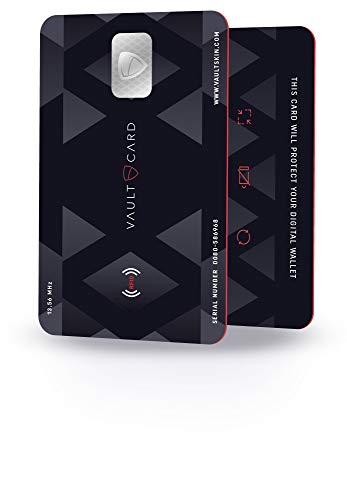
Best for those who value proven electromagnetic jamming technology. VaultCARD reports military-style electromagnetic shielding to guard RFID-enabled cards and even passports. It provides convenient wallet integration without requiring a separate sleeve for each card.
Who it’s best for: users seeking a single, low-bulk block that covers a broad set of RFID-enabled items. Caution: some travelers prefer explicit, independently tested protection for passport use beyond standard cards.
KF-Premium RFID Blocking Card (2 Pack)

Better for households that want one universal shield for multiple wallets or a spare for travel. A single KF-Premium card claims to shield the entire wallet by emitting an interfering counter-signal, blocking RFID and NFC readers from skimming nearby cards.
Who it’s best for: families or individuals who want a single-card solution across different wallets. Caution: ultra-thin design requires careful handling to prevent misalignment with other cards in crowded wallets.
Buying Guide: RFID Blocking Card Essentials
What to look for when choosing an RFID blocking card
- Blocking technology: Seek cards that describe an active jamming signal or electromagnetic shielding to stop unauthorized reads, not just passive shielding.
- Operating distance: A larger working distance, such as 2.4 inches, provides protection for the entire wallet rather than just a single card.
- Card thickness: Ultra-thin cards (roughly 0.9–0.76 mm) fit easily into standard wallet slots without adding noticeable bulk.
- Material and durability: Look for durable materials that resist bending and wear, especially if you carry multiple cards.
- Pack size and value: For households or frequent travelers, consider multi-pack sets for convenience and cost efficiency.
- Interference with other cards: Ensure the blocker does not demagnetize or interfere with your own cards’ operation.
How to choose between a multi-pack and a single-card solution
- Multi-pack: Best for families or shoppers who want replacements or backups across several wallets.
- Single-card shield: Best for minimalists who carry a few essential cards and want maximum wallet space.
Compatibility and practical use tips
- Place the blocker in a wallet pocket where it remains flat and unobstructive to other cards.
- Avoid relying on a blocker as your only security measure; use it in combination with normal security practices (account monitoring, PINs, and protective wearables).
- Ensure you do not accidentally insert it in a way that could hinder your own card reads during legitimate transactions.
FAQ
- Do RFID blocking cards protect passports and IDs?
Yes, many blockers are designed to shield RFID-enabled cards, like passports and IDs, in addition to payment cards.
- Will using a blocking card affect contactless payments at points of sale?
Blocking cards are meant to prevent unauthorized skimming; they should not impede legitimate transactions when properly used in a wallet slot away from the reader.
- How thick is an RFID blocking card?
Most blocking cards are between 0.76 mm and 0.9 mm thick, roughly the same as a standard credit card.
- How far can blocking technology reach?
Some models advertise a working distance around 2.4 inches, which covers the bulk of a typical wallet.
- Should I buy a set or a single card?
Set options are cost-effective for households or travel needs, while a single card fits compact wallets or personal use.
- Can RFID blocking cards interfere with NFC-enabled devices?
Blocking cards are designed to shield from readers, not to interfere with your own devices or transactions when used properly in a wallet.