Answering the demand for precise yaw control in consumer flight sims, this guide compares top-rated rudder pedals. It highlights models suited for beginners seeking smoother steering and seasoned sim pilots requiring finer, repeatable inputs. The selections below focus on compatibility with PC, consoles, and common flight sims, plus options with adjustable tension, self-centering action, and integrated brakes. Ideal buyers include casual hobbyists, combat and civil aviation enthusiasts, and those building a complete HOTAS or cockpit setup. A quick comparison table follows to help you decide at a glance.
| Product | Best For | Key Feature | Notes |
|---|---|---|---|
| Logitech G Pro Flight Rudder Pedals | Casual to intermediate sim users | Self-centering with adjustable tension | Differential toe brakes for taxi and rollout |
| Thrustmaster TFRP Precision Flight Sim Rudder Pedals | PS5, Xbox, PC gamers | Long travel rudder axis | Balanced, self-centering, realistic feel |
| Thrustmaster T-Flight Full Kit HOTAS With Rudder Pedals | Complete cockpit experience | Full HOTAS with included pedals | Xbox Series X|S compatible |
| Thrustmaster TPR Rudder Pedals | PC sim enthusiasts | Pendul_r mechanism with HallEffect | Ultra-precise inputs, customizable springs |
| OYDL SN-2 Flight Rudder Pedals | Adjustable damping, damped feel | CNC-cut aluminum, multi-angle adjustment | Includes braking system and many pedal positions |
Logitech G Pro Flight Rudder Pedals
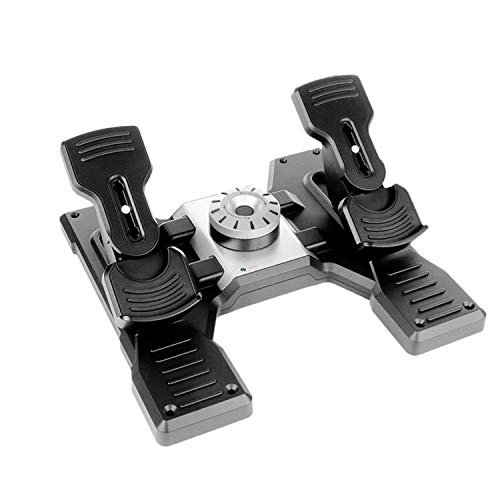
Best for beginners and intermediate simmers who want reliable self-centering pedals with simple adjustments. The Logitech G Pro features smooth, accurate rudder action and an Adjustable Tension Dial to tailor stiffness for lighter light-aircraft handling or heavier jet inputs. Differential toe brakes provide independent braking on each pedal, useful for precise taxiing and ground handling. A potential limitation is the lighter overall weight, which some setups might complement with a sturdy base or cockpit frame to reduce movement during aggressive maneuvers.
Who it’s for: Casual pilots starting with civil and light-aircraft sims, or hobbyists building a desktop cockpit who want straightforward setup and dependable toe braking. Why selected: It emphasizes consistency, ease of use, and expandable control within a compact design.
Thrustmaster TFRP Precision Flight Sim Rudder Pedals

Best for multi-platform flight sims, including Microsoft Flight Simulator, on PS5, Xbox, and PC. The TFRP delivers a long travel rudder axis for smooth, realistic turns and coordinated flight. Its self-centering mechanism provides a natural return, which helps reduce fatigue during long sessions. Limitation: as a mid-range option, it may not offer the deepest customization some enthusiasts desire, compared to higher-end pendulum or magnetic sensor systems.
Who it’s for: Console and PC gamers who want a robust, cross-platform pedal solution with realistic travel. Why selected: It balances travel, centering, and compatibility in a single package.
Thrustmaster T-Flight Full Kit HOTAS With Rudder Pedals

Best for a complete cockpit experience, this kit combines a full hands-on throttle and stick system with integrated rudder pedals. It supports Xbox Series X|S and PC, enabling smooth control across diverse aircraft and missions. The included TFRP pedals utilize Thrustmaster’s S.M.A.R.T slide rail system, delivering ultra-smooth steering with reduced jerks. Limitation: the bundle targets users wanting a complete setup; integration with non-Thrustmaster gear may require additional adapters or configurations.
Who it’s for: Fans of immersive, all-in-one flight sims who want cohesive hardware. Why selected: It bundles the core flight controls into a single, coherent system with strong ground handling fidelity.
Thrustmaster TPR Rudder Pedals, Flight Simulator Rudder Control

Best for serious PC sim enthusiasts seeking high-precision input, thanks to Pendulum_r technology and HallEffect magnetic sensors. The TPR pedals deliver exceptionally smooth, realistic pedal motion with reduced mechanical wear and tear, maintaining accuracy over time. The adjustable spring system lets you tailor pedal resistance for combat, commercial, or general aviation. Limitation: magnetic sensors offer precision, but some users may prefer direct-drive or more advanced magnetic systems for extreme workloads.
Who it’s for: Pilots focusing on realism and enduring performance in PC-only sims. Why selected: It combines fluid motion with long-term reliability and customization options.
OYDL SN-2 Helicopters Flight Rudder Pedals

Best for pilots who want adjustable damping and a robust aluminum construction. The SN-2 includes multi-angle adjustment, five pedal holes, and a damping system to provide stable return-to-center feedback. Brake capabilities are integrated, enabling more authentic taxiing and ground handling. Limitation: assembly complexity can be higher due to multiple adjustment options and the need to secure a stable platform in your cockpit setup.
Who it’s for: Flight sim enthusiasts building a more serious ground-control station with custom damping and braking. Why selected: Offers adjustable damping and a metal build with extensive position options for personalized feel.
XINGBIRDS Upgraded Spring For Thrustmaster TFRP

Best as an upgrade option for TFRP users wanting to customize pedal spring resistance. The package includes two spring options, medium and high rebound strength, enabling re-tuning for preferred stiffness. Limitation: this accessory does not add new travel or sensors but changes feel, which may require experimentation for optimal balance with your existing pedals.
Who it’s for: TFRP owners who want to fine-tune pedal feel without replacing the entire pedal unit. Why selected: Provides a practical, low-cost way to tailor stability and feedback.
Buying Guide: Key Considerations For Rudder Pedals
- Platform compatibility: Check whether pedals support PC, Xbox, PS5, or cross-compatibility. Some models are console-friendly, others are PC-focused.
- Travel and resistance: Longer pedal travel and adjustable springs or dampers produce more realistic control for different aircraft types.
- Centering and stability: Self-centering action versus non-centering affects how pedals return to neutral and affect taxiing accuracy.
- Brake integration: Differential toe brakes are essential for realistic ground handling; verify if the pedal system includes them.
- Mounting requirements: Some pedals require a dedicated stand or cockpit mounting; ensure your desk or frame can support them.
- Sensor technology: Pendulum_r and HallEffect systems provide smooth motion and long-term accuracy; consider maintenance and precision needs.
- Future expansion: If you plan a broader setup (HOTAS, throttle, yoke), consider how pedals integrate with other controls.
FAQ
- Q: Are rudder pedals necessary for flight sims? A: They improve yaw control, realism, and ground handling, especially in larger aircraft and complex scenarios.
- Q: Which pedals are best for console use? A: Pedals advertised for PS5 or Xbox compatibility, such as Thrustmaster TFRP, are suitable.
- Q: Do pedals come with brakes? A: Some models include differential toe brakes; others require separate components or upgrades.
- Q: Can I upgrade pedals without replacing the entire setup? A: Yes, many pedal options offer modularity or accessory springs and dampers to tailor feel.
- Q: How important is sensor type? A: HallEffect and Pendulum_r sensors reduce wear, maintain accuracy, and deliver smoother inputs over time.
- Q: Should I choose a full HOTAS kit? A: If you want an all-in-one cockpit experience, a full HOTAS with pedals can provide cohesive control and workflow.