Answering the search for a small ATX case that still fits high-performance components and good cooling, these picks emphasize compact footprint with ample airflow and expandability. Best for compact desktop builds, small living-room setups, or any build where space is premium, these cases balance size with cooling, cable management, and upgrade potential. The table below highlights why each model stands out for different buyer needs.
| Product | Why It Stands Out | Best For |
|---|---|---|
| NZXT H5 Flow | Excellent GPU cooling with dual 120mm intake options and strong radiator support for liquid cooling | Compact high-performance builds needing robust cooling |
| Lian Li O11D MINI V2 Flow | Pre-installed fans and optimized airflow with a compact footprint and stylish visibility | Showcase builds that prioritize aesthetics and cooling |
| Cooler Master Q300L V1 | Ample interior for Micro-ATX and Mini-ITX, flexible cooling options | Budget-conscious, space-saving micro-ATX/mini-ITX builds |
| ASUS Prime AP303 | Maximal capacity in a compact size with strong GPU and radiator support | Balanced performance builds with room for future upgrades |
| Corsair 4000D RS ARGB | Modular FRAME system and pre-installed ARGB fans for flexible layouts | configurations that value customization and bright lighting |
NZXT H5 Flow – Compact ATX Mid-Tower

The NZXT H5 Flow is designed for compact ATX builds with strong cooling potential. It supports up to a 360mm radiator in front and a 240mm radiator on top, enabling serious liquid cooling capability in a smaller footprint. The top, front, and side panels feature Ultra-fine mesh to optimize airflow while helping to filter dust. This case is best for enthusiasts who want a space-efficient chassis without sacrificing cooling performance. Limitations to note include the need to source compatible fans, as the top and front radiators require appropriate fans for optimal operation.
Lian Li O11D MINI V2 Flow-ATX Mid-Tower
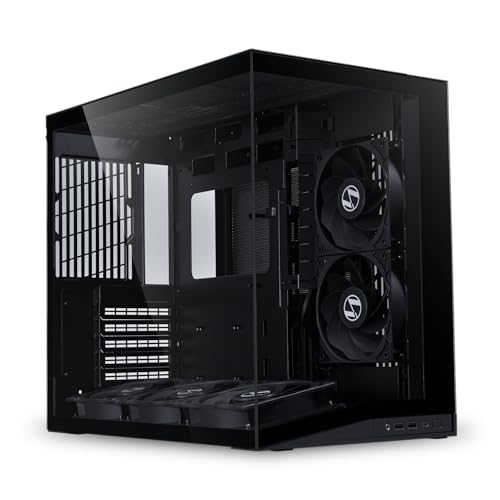
The Lian Li O11D MINI V2 Flow comes with five pre-installed 120mm fans, optimized airflow, and a compact form factor with a slanted bottom design that improves direct cold air intake and GPU cooling. The pillar-less tempered glass panels showcase the build, making it ideal for visually striking setups. This is a strong pick for users who want prominent airflow performance and a premium look in a smaller ATX footprint. A potential limitation is the density of pre-installed fans on a compact case, which may constrain how users manage cable routing under heavy components.
Cooler Master Q300L V1 Micro-ATX

The Cooler Master Q300L V1 focuses on interior space for Micro-ATX and Mini-ITX builds with clearances suitable for CPU coolers up to 159mm in height, GPUs up to 360mm, and PSUs up to 160mm. It supports a 240mm liquid cooler and up to five fans for versatile cooling. Choose this if you want a budget-friendly, highly flexible small-form-factor chassis that accepts larger GPUs in a compact body. The trade-off is that Micro-ATX and Mini-ITX boards limit some expansion compared to full ATX designs.
Corsair 4000D RS ARGB

The Corsair 4000D RS ARGB Frame offers modular expansion through the FRAME system, letting builders swap panels or adjust the front I/O to suit evolving needs. It ships with three pre-installed RS ARGB fans and supports a flexible front-to-roof fan configuration via the InfiniRail mounting system. This case is best for users who desire a scalable, visually striking build with easy customization. A limitation might be the need to manage ARGB connections through the motherboard to achieve seamless lighting across components.
Buying Guide
What should you consider when choosing a small ATX case?
- Cooling capacity: Look for radiator support and multiple fan mounting options to keep high-performance components cool in a compact space.
- GPU length and clearance: Check the maximum GPU length accepted by the case to ensure your graphics card fits without blocking other components.
- Motherboard compatibility: Ensure the chassis supports ATX boards if you plan to upgrade within that standard; many compact cases favor Micro-ATX or Mini-ITX.
- Cable management: Favor cases with hidden compartments, generous routing channels, and Velcro/strap options to keep airflow unobstructed.
- Expansion and modularity: Consider cases with flexible mounting systems, removable panels, and ARGB or RGB options if aesthetics matter.
- Build accessibility: A broad side panel, tool-less drive bays, and accessible I/O panels simplify assembly and upgrades.
Frequently Asked Questions
- What is a small ATX case best for?
Answer: Small ATX cases suit compact desks, living rooms, or rooms with limited space while still supporting ATX motherboards and mid-range GPUs for balanced builds. - Can a 360mm radiator fit in a small ATX case?
Answer: Some models (like NZXT H5 Flow) offer front radiator support up to 360mm, but availability depends on the specific case’s internal layout. - Are pre-installed fans common in compact cases?
Answer: Yes; several compact cases ship with multiple pre-installed fans to help achieve immediate cooling performance. - Is ARGB lighting a deciding factor in small cases?
Answer: ARGB lighting is a visual enhancement; choose a model with ARGB if you want synchronized lighting, otherwise consider cases without lighting for a simpler setup. - Should I prioritize modularity over raw size in a small case?
Answer: Modularity helps future upgrades and layout customization, especially in space-constrained builds where airflow and cable management are critical.