Discover compact, capable sound for your computer setup. This guide highlights small, USB-powered or mini-powered speakers that deliver clear audio, easy setup, and solid value. The selected options suit students, home offices, gamers, and professionals who need desk-friendly speakers without sacrificing sound quality. Each entry includes who it’s best for and why, plus a practical caveat to consider before you buy.
| Product | Best For | Key Benefit | Limitations |
|---|---|---|---|
| [Upgraded] LIELONGREN USB Computer Speakers | Windows, Mac, Linux users needing plug-and-play | Broad compatibility with easy USB setup | May require driver updates for some systems |
| Amazon Basics Stereo 2.0 Speakers | Budget-conscious, dual-speaker setup | Simple USB-powered dual speaker pair with inline volume | No built-in Bluetooth or advanced controls |
| XKX Computer Speakers | USB-C device users and modern laptops | USB-C to USB adapter included; strong bass | May be overwhelming for small desks in quiet rooms |
| Creative Pebble | Compact desktops and desks with strong audio projection | Far-field drivers and 45° elevated placement | No separate subwoofer for deeper bass |
| Uakinat Computer Speakers | Plug-and-play, small footprint, versatile use | USB powered with 3.5mm input for convenience | Compact design limits very high-volume performance |
Note: All product details are based on listed features. This guide focuses on practical differences to help buyers pick the right small computer speakers for their setup.
[Upgraded] LIELONGREN USB Computer Speakers

- Compatibility: Works with Windows PCs (7/8/10/11) and various brands; supports macOS, Linux, and Chrome OS with updated drivers.
- Plug-and-Play: USB connection is straightforward—select the speaker as playback device in Windows.
- Best For: Buyers who want broad OS compatibility and simple setup without extra software.
- Limitation: Some users may need driver updates for full OS compatibility on certain machines.
Amazon Basics Stereo 2.0 Speakers

- Two-Speaker Setup: External PC or laptop audio amplified via USB power.
- Volume Control: Inline volume control for quick adjustments.
- Best For: Users who want a straightforward, budget-friendly stereo pair with easy access.
- Limitation: Lacks built-in Bluetooth and advanced audio features.
XKX Computer Speakers

- USB Compatibility: Works with Windows, macOS, ChromeOS, and Linux; includes built-in USB-C adapter for USB-C devices.
- Power and Bass: Dual drivers with passive radiators provide loud sound and deeper bass for its size.
- Best For: Modern devices with USB-C or USB-A ports seeking simple, compact speakers.
- Limitation: May be less suitable for very quiet environments due to strong output.
Creative Pebble 2.0
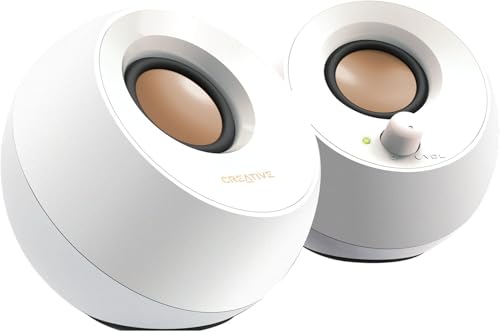
- Design and Sound: Far-field drivers and rear passive radiators; 45° elevated drivers for better projection.
- Connectivity: USB power with 3.5 mm AUX-in for easy pairing.
- Best For: Desks needing a compact, stylish speaker with surprisingly strong room-fill sound.
- Limitation: Lacks a separate subwoofer for deeper bass in very bass-heavy content.
Uakinat Computer Speakers

- Plug-and-Play: USB-powered with a 3.5 mm audio cable; no drivers required.
- Compact and Stylish: Small footprint suitable for tight desks and modern setups.
- Best For: Users who want quick setup and compatibility with both PCs and laptops via a single USB connection.
- Limitation: Very high-volume performance might be limited by the compact size.
Buying Guide
What should I consider when buying small computer speakers?
First, determine your device compatibility. If you primarily use Windows or macOS laptops, USB-powered options are typically simplest. USB-C compatibility is a plus for newer Macs and devices that rely on USB-C ports.
Which power option fits my setup?
USB-powered speakers are ideal for clean desks with minimal cables. If you have a monitor with USB hub support, clip-on or monitor-integrated speakers can reduce clutter without sacrificing audio quality.
Do I need bass or just clear mids and highs?
For movie watching or gaming, models with dual drivers and passive radiators tend to deliver better bass without a subwoofer. If you mostly listen to spoken content, clear mids and highs with good imaging may be more important than deep bass.
How important is size and desk space?
Compact, 2.0 or 2.1 systems fit small desks well. Consider the speaker orientation, such as 45° elevation, to project sound toward your ears in a typical seated position.
What about controls and convenience?
Inline volume control and headphone jacks add usability. Some models offer simple plug-and-play with minimal driver requirements, which is convenient for shared computers or classrooms.
What are common limitations to watch for?
Small speakers can struggle to deliver chest-thumping bass or very high volume in large rooms. The absence of Bluetooth or subwoofers means you trade off wireless convenience or extended low-end capability for compact size and desk-friendly form.
Practical comparison tips
- Best for Windows and Mac users: LIELONGREN and XKX offer broad OS support with straightforward setup.
- Budget-first choice: Amazon Basics 2.0 provides reliable stereo sound without extra features.
- Best desk space saver: Creative Pebble combines compact design with thoughtful sound projection.
- USB-C ready: XKX and similar options simplify use with newer laptops and devices.
FAQ
- Do small computer speakers need a separate power adapter?
Most listed options are USB-powered, drawing power from the computer, which eliminates extra wall adapters.
- Is 2.0 stereo enough for gaming?
Yes for close-range listening; many 2.0 systems offer clear sound and adequate bass through dual drivers and passive radiators.
- Can I use these with a monitor alone?
Some models attach or sit under monitors and work as monitor speakers, but check compatibility with your monitor’s audio outputs.
- Which is best for travel or mobile use?
USB-powered, compact speakers with simple plug-and-play are easiest to move between desks and devices.
- Do these speakers work with Linux or Chrome OS?
Many options list Linux and Chrome OS compatibility, especially those marketed for cross-platform PC use.
- Should I avoid any models for quiet rooms?
Models with high-output bass or aggressive amplification may be less suited for quiet, small spaces.