Looking for a reliable smart security camera system? This guide highlights five popular options that balance price, battery life, and video quality. Best for renters or small homes are battery-powered cams with simple setup. Best for pet households emphasize 2-way audio and motion alerts. Better for family safety are indoor cameras with wide viewing angles and night vision. Each option includes who it’s best for and why it fits that scenario.
| Product | Brand | Best For | Key Benefit |
|---|---|---|---|
| Blink Outdoor 4 – 2-Camera System | Blink | Homeowners seeking battery-powered outdoor coverage | Up to two-year battery life with 1080p live view |
| TP-Link Tapo C100 Indoor Security Camera | TP-Link | Indoor monitoring and baby/pet watching | Clear 1080p, 2-Way Audio, night vision |
| Blink Outdoor 4 – 2-Camera System (Add-On) | Blink | Expand outdoor coverage with add-on camera | Same 1080p view, simple integration |
| WESECUU Light Bulb Security Camera | WESECUU | Discreet outdoor/wide-angle monitoring | Dual-band WiFi and color night vision |
| Tapo 2K Pan/Tilt Indoor Camera (C210P2) | TP-Link | Indoor full-room coverage | 2K resolution with pan/tilt for broad view |
Blink Outdoor 4 – 2-Camera System

Best for: Homeowners needing weatherproof outdoor coverage with long battery life. Why selected: This system emphasizes maintenance-free operation with up to two years of battery life per camera. It supports 1080p HD live view and infrared night vision, with two-way audio for quick communication. Limitations: Local storage is not included with the included Sync Module Core, so some setups rely on cloud storage or additional modules.
TP-Link Tapo 1080P Indoor Security Camera (C100)

Best for: Indoor home monitoring, baby or pet surveillance. Why selected: The C100 delivers 1080p video, motion detection with instant notifications, and built-in two-way audio with a siren. It works with Alexa and Google Home. Limitations: Requires 2.4GHz Wi‑Fi; no built-in long-range audio enhancements beyond standard two-way talk.
Blink Outdoor 4 – 2-Camera System (Add-On)

Best for: Expanding existing Blink setups with additional outdoor coverage. Why selected: This add-on camera mirrors the main system’s capabilities, including 1080p HD video and infrared night vision, with easy setup alongside a Blink Sync Module. Limitations: Requires a Blink Sync Module (sold separately) for full operation.
WESECUU Light Bulb Security Camera
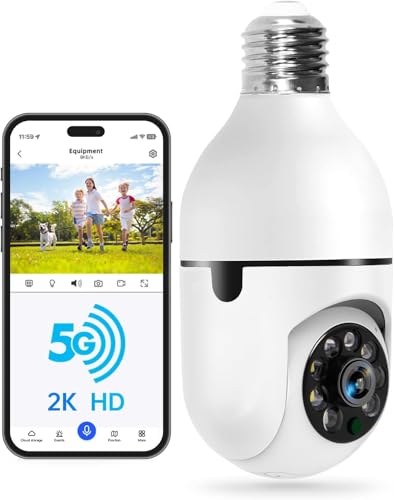
Best for: Discreet outdoor or indoor monitoring with flexible lighting. Why selected: This bulb camera uses 5G & 2.4G dual-band WiFi for a stable connection, with two-way audio and real-time alerts. It supports motion and human detection to reduce false alarms. Limitation: Requires E27 bulb base installation and consistent power supply for continuous operation.
Tapo 2K Pan/Tilt Security Camera (C210P2)

Best for: Indoor coverage of large rooms or hallways with flexible viewing. Why selected: The 2K resolution and 360° horizontal with 114° vertical range enable comprehensive monitoring. It supports instant notifications for motion, person, or baby crying. Limitation: Indoor use is implied; performance depends on stable Wi-Fi and proper placement.
Blink Mini 2K+

Best for: Compact indoor security with enhanced video clarity. Why selected: The Mini 2K+ offers sharper 2K video, improved audio, and reliable motion detection in a compact plug-in form factor. Limitation: Primarily designed for indoor use and small spaces; battery-free design requires constant power.
Buying Guide: Key Purchase Considerations
- Outdoor vs indoor placement: Battery-powered options like Blink Outdoor 4 provide flexible placement outdoors but may require battery replacements over time, while indoor cameras focus on room-wide coverage and power reliability.
- Video resolution and night vision: For detailed footage, prioritize 2K or 1080p with infrared night vision. Consider cameras with wide dynamic range for variable lighting.
- Two-way audio and alarms: Two-way talk helps with real-time communication. Built-in sirens or alarm features can deter intruders.
- Storage options: Local storage with a module can reduce cloud fees, but many systems use cloud storage or require additional modules. Assess your privacy and budget needs.
- Connectivity: Dual-band WiFi and stable router placement improve reliability. Ensure devices support your home network band (2.4 GHz vs 5 GHz).
- Expandability: If you want more cameras later, choose systems that support add-ons or multi-camera configurations without heavy reconfiguration.
- Smart home compatibility: Look for compatibility with Alexa or Google Assistant for voice control and routines.
Frequently Asked Questions
- What’s the main difference between indoor and outdoor cameras?
Outdoor cameras are weather-resistant and designed for external environments, while indoor cameras focus on interior spaces and lighting conditions. - Do battery-powered cameras require frequent replacements?
Battery life varies by model and usage, but many systems advertise months to years between changes with efficient power management. - Is local storage necessary for security cameras?
Local storage reduces cloud reliance and monthly fees, but cloud options offer remote access and backup in case of local theft or damage. - Can these cameras deter crime effectively?
Effective deterrence comes from real-time alerts, visible cameras, and quick access to live feeds or two-way audio to communicate with visitors. - What should I consider when expanding a camera system?
Ensure compatibility across devices, consistent power options, and the ability to add cameras without significant reconfiguration. - Are these cameras compatible with smart home assistants?
Many models supportAlexa or Google Assistant for voice control and routine integration; check each product’s compatibility details.