If you need to run multiple speaker sets from one or two amplifiers, a speaker switch box is the simplest, safest, and most reliable solution. This guide highlights five solid options, explaining who each is best for, and why it was selected. Ideal buyers include home theater setups, multi-room music fans, and anyone who wants easy, push‑button switching without signal loss or impedance issues.
Summary table of selected products:
| Product | Best For | Key Benefit | Notes |
|---|---|---|---|
| Pyle 4-Channel High Power Stereo Speaker Selector | Homes with 4 pairs of speakers | Handles 100W per channel; supports 8 Ohms minimum | Traditional multi‑zone setup |
| SOLUPEAK P2 2 Way Amp/Speaker Switch | Two devices to one or one to two | Versatile 2‑IN/1‑OUT or 1‑IN/2‑OUT | Passive, plug‑and‑play |
| PROZOR 2‑Zone Passive Speaker Switch | Two zones with independent control | Independent A/B zones; no power needed | Simple yet flexible |
| TENEALAY 2‑Way Audio Switch | Two pairs of speakers | Solid 2‑pair control; 80W per channel | Compact, safe for home theater |
| PROZOR 4‑Zone Passive Switch | Four zones from one amp | Independent A/B/C/D, built‑in protection | Good for multi‑room, patio, or studio |
Pyle 4-Channel High Power Stereo Speaker Selector – A/B/C/D

Best for users who need four independent speaker pairs controlled from a single source. This unit supports up to 100 watts per channel and requires 8 Ohm minimum impedance. It accepts up to 14‑ga speaker wires, making it suitable for reasonably long runs in a home theater or larger living area. Choose this if you want a straightforward, no‑frills selector with strong channel separation. Caution: not ideal for very high impedance or very low impedance loads beyond 8 Ohms.
SOLUPEAK P2 2 Way Amp/Speaker Switch Selector Box
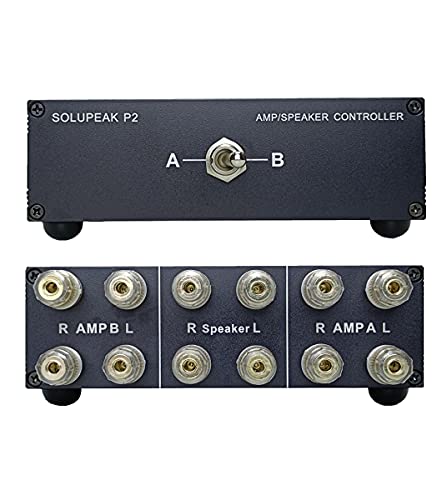
Best for comparing two amplifiers or two speaker pairs with quick, one‑press switching. This passive device works without external power and uses gold‑plated banana jacks to support up to 12‑ga wires. It is a good pick for users who want a simple, compact comparison tool without signal processing. Caution: A/B switching is not designed for simultaneous playback from both amps or speakers; only one path is active at a time.
PROZOR 2-Zone Passive Speaker Switch Box

Best for two zones when you want straightforward, no‑power operation. This box lets you run one amplifier to two speaker pairs or two amplifiers to one speaker pair, with independent A/B zone switching. It’s a solid choice for home theaters or smaller rooms where you don’t need extra amplification or complex routing. Caution: only one input can play at a time, which is important for avoiding short circuits or unwanted mixing.
TENEALAY 2-Way Audio Speaker Selector

Best for two pairs of speakers sharing a stereo amplifier. It supports up to 80W per channel and is designed for 8–16 Ohm impedance speakers. This model is well suited for compact home theater or two‑zone music listening. Limitation: higher power or more zones are not supported; best kept to two speaker pairs.
PROZOR 2(1)-in-1(2)-Out Amp/Speaker Switch

Best for setups needing two sources to one set of speakers or one source to two sets. This selector supports two amps to one speaker pair or one amp to two pairs, with a clear one‑position‑at‑a‑time operation. It’s a practical choice when you want to centralize two inputs without running extra cabling to multiple rooms. Caution: only one input active at any moment to avoid conflicts.
Pyle 8 Channel Speaker Selector Switch
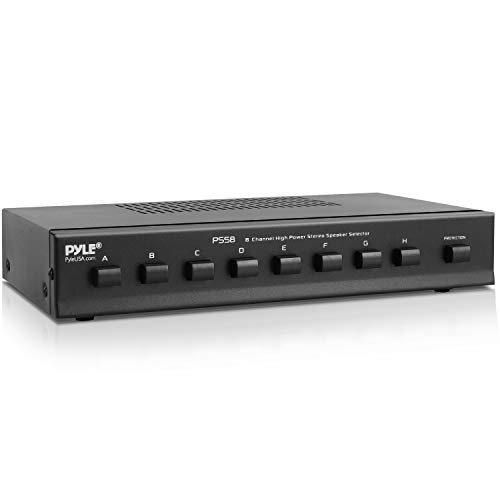
Best for multi‑room or larger homes needing eight speaker zones. It supports up to eight speaker pairs and includes independent on/off and selection controls. This is suitable where you want centralized control for multiple rooms without frequent reconfiguration. Caution: higher channel count may require careful impedance matching to avoid overloading the amplifier.
PROZOR 4-Zone Speaker Selector Switch

Best for four zones from a single amplifier with independent A/B/C/D controls and a built‑in power management approach. The design emphasizes safe daily operation with an AMP master switch to mute all zones when needed and practical protection for internal circuitry. This makes it a good fit for dedicated studios, patios, or home offices requiring reliable four‑zone distribution. Limitation: the unit is passive, so there is no signal processing or volume augmentation beyond what your amp provides.
Buying Guide: Key Considerations for Choosing a Speaker Switch Box
- Number of zones and inputs: How many speaker pairs do you need to manage, and do you require one or two amplifier inputs?
- Power handling and impedance: Ensure the switch is rated for your amplifier’s power and your speaker impedance (typically 8 Ohms in consumer setups).
- Passive vs. powered: Passive switches require no power; powered options can offer added features like volume control or signal conditioning, but add complexity.
- Wiring and connectors: Check wire gauge compatibility and whether banana jacks or bare wire connections are supported; some models prefer banana plugs.
- Protection and safety: Look for features like a master amp switch, short‑circuit protection, and clear labeling to prevent improper connections.
- Size and installation: Consider the physical footprint and whether the device will sit on a rack, shelf, or desktop space.
- Sound integrity: Choose devices with simple signal paths and minimal cross‑talk to preserve audio quality across zones.
FAQ
- What is a speaker switch box used for? – It distributes audio from one or more amplifiers to multiple speaker pairs, enabling easy switching between zones without rewiring.
- Is a powered speaker switch better than a passive one? – Powered switches can add features like volume control, but a passive switch avoids power needs and potential noise from electronics.
- Can I use these with a soundbar or home theater receiver? – Yes, as long as the impedance and power ratings match the receiver’s outputs and the switch’s specs.
- Do these devices affect audio quality? – A well‑designed switch with proper impedance matching preserves signal integrity and minimizes loss or distortion.
- How many speakers can I run from a single amp? – It depends on the amp’s wattage and the switch’s per‑channel rating; always verify impedance and current limits first.
- Do I need a separate switch for each room? – Not necessarily; multi‑zone switches can handle several rooms in a single box, simplifying setup and cabling.