Answer: A 5.8GHz wireless system delivers the most stable, interference-resistant signal for live playing and recording, with 24-bit/48 kHz audio and low latency. This guide selects five top options to fit different needs, from stage-ready kits to practice-friendly setups. Best for gigging guitarists, studio players, and worship teams seeking reliable wireless tone without dropouts.
Buyer snapshot: The following picks cover a range of use cases—compact practice setups, live performances, and venues with crowding or interference. The table summarizes key strengths and ideal buyers for quick comparison.
| Product | Best For | Key Strength |
|---|---|---|
| JOYO JW-06 | Home practice, small gigs, worship teams | Low latency 5.8GHz, long battery life with charging case |
| LEKATO 5.8GHz | Live stage, studio practice | High-grade wireless, 24-bit/48kHz, rotatable plug |
| JOYO JW-03 | Budget-friendly practice and small venues | 2.4GHz, up to 8 hours, 65ft range |
| Xvive AC58 | Stage performers with charging flexibility | 5.8GHz, charging case with up to 2 full charges |
| Fender Telepath | Pro-level reliability, multiple instruments | 5.8GHz, broad compatibility |
JOYO JW-06 5.8GHz Wireless Guitar System

Best for: Home practice, rehearsals, and small gigs where stable, low-latency wireless is essential. The JW-06 uses a 5.8GHz digital transmission with 48K/24-bit audio and latency under 6 ms, preserving guitar tone with minimal delay.
Why chosen: It combines long battery life (up to 18 hours total with charging case) and a stable open-area range of 65–100 feet, with the option to switch channels to avoid interference. The included charging case supports multiple recharges for on-the-go use.
Caution: In highly obstructed spaces, the effective range may drop; test in your venue beforehand to identify optimal channel settings.
LEKATO 5.8GHz Wireless Guitar System
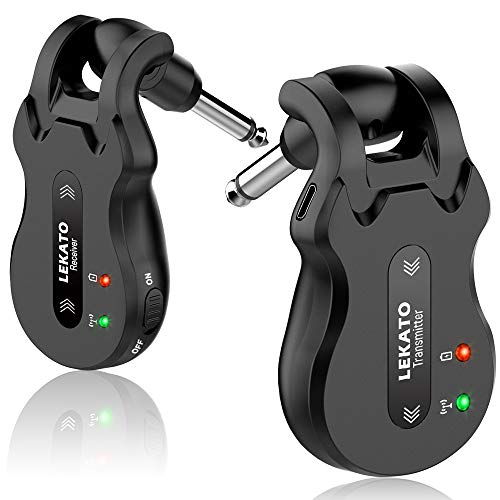
Best for: Live stage and studio practice where higher interference resistance matters and a rotatable plug helps fit tight instrument jack configurations.
Why chosen: Delivers 24-bit/48kHz audio with latency under 6 ms and a practical 100-foot range. Built-in rechargeable battery supports up to 5 hours per charge, with a dual USB charging cable for convenience on long gig days.
Caution: Battery life is not exceptionally long for all-night events; plan for quick recharges between sets if needed.
JOYO JW-03 2.4GHz Wireless Guitar System
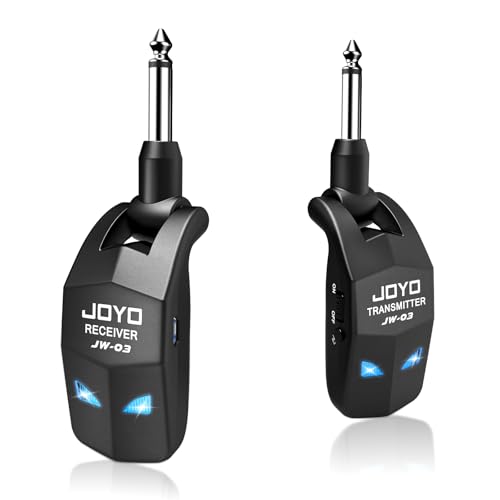
Best for: Budget-conscious players seeking reliable wireless for home use and small venues.
Why chosen: The JW-03 offers up to 8 hours of playtime per charge and a 65-foot practical range with 2.4GHz operation. The 220° rotatable plug improves compatibility with awkward guitar jack placements.
Caution: Not recommended for large stages or environments crowded with Wi‑Fi or Bluetooth devices due to 2.4GHz congestion.
Xvive AC58 Wireless Guitar System With Charging Case

Best for: Musicians who want reliable 5.8GHz wireless with easy charging options for frequent stage use.
Why chosen: The AC58 kit includes a charging case that can top up the transmitter and receiver up to two full charges, supporting longer performance windows. It uses a true 5.8GHz diversity system for reduced interference and 24-bit/48kHz audio.
Caution: Like other 5.8GHz setups, performance can still vary with venue layout and nearby RF activity; testing in advance remains advisable.
Xvive AC58 Wireless Guitar System 5.8GHz Transmitter and Receiver

Best for: Stage performers needing a broad working range and low latency across multiple show setups.
Why chosen: This 5.8GHz system emphasizes low latency (under 5 ms) and supports up to four simultaneous pairs, offering flexibility for complex stage rigs and multi-instrument setups.
Caution: Ensure channels are tuned to avoid interference in crowded venues with many wireless devices.
INGPARTNER 2.4GHz Wireless Guitar System

Best for: Entry-level players seeking straightforward plug-and-play wireless with decent range.
Why chosen: It features a simple setup with less than 4 ms latency and up to 100 feet transmission distance. The rechargeable batteries and dual USB cabling simplify on-the-road charging.
Caution: 2.4GHz operation can be more susceptible to interference inWi-Fi-dense environments; test in your space before performances.
Fender Telepath Wireless System

Best for: Pro-level players who value strong signal integrity and broad instrument compatibility.
Why chosen: The 5.8GHz digital transmission reduces interference, providing reliable full-frequency wireless audio. It is designed for universal compatibility with active and passive instruments, making it adaptable for guitar, bass, and other output signals.
Caution: Availability and compatibility can vary by market; confirm that the system matches your instrument and usage needs before purchasing.
Buying Guide
What should you consider before buying a wireless guitar system?
- Frequency band: 5.8GHz systems generally offer better stability and less congestion than 2.4GHz in crowded venues; decide if you need the extra range or device compatibility.
- Latency: Look for sub-6 ms latency for real-time playing feel. Lower latency reduces perceived delay between picking and sound output.
- Range: Consider your typical performance space. If you perform large rooms or outdoors, prioritize a system with 60–100+ feet of usable range.
- Battery life and charging: Systems with longer battery life and a charging case reduce downtime between sets.
- Plug design: A rotatable 1/4″ plug helps in tight spaces or unconventional guitar body shapes.
- Interference management: Some systems offer channel switching or true diversity to minimize dropouts in RF-dense environments.
FAQs
- Q: What is the main difference between 5.8GHz and 2.4GHz wireless guitar systems? A: 5.8GHz typically offers stronger, more stable signals with less interference, while 2.4GHz can be more prone to congestion in busy RF environments.
- Q: Is low latency important for practice at home? A: Yes, low latency preserves the natural feel of playing and reduces perceived timing discrepancies.
- Q: Can I use multiple wireless systems simultaneously on stage? A: Some models support multiple pairs; check the product’s channel options and interference management features.
- Q: Do wireless systems affect guitar tone? A: Quality systems aim to preserve original tone; however, best results come from low-latency, high-fidelity units with good shielding.
- Q: How do I determine the right range for my venue? A: Consider the largest distance between you and the audience or other players, plus potential obstructions like walls and furniture.
- Q: Are charging cases essential? A: They are beneficial for longer events and frequent practice, as they provide on-the-go charging between uses.