Find the right outdoor TV antenna for reliable local channels without monthly fees. This guide highlights five top picks suited for rural, suburban, and urban settings, focusing on long-range reception, durability, and ease of installation. Each product is evaluated for who it’s best for, and why it’s chosen.
| Product | Best For | Key Benefit |
|---|---|---|
| GE Outdoor HD Digital TV Antenna | General Local Viewing | Long-range reception up to 70+ miles |
| PBD Amplified Outdoor TV Antenna | Rural or obstructed areas | 360° rotation and strong signal with amplifier |
| Antennas Direct ClearStream 4V | Multi-room or attic installations | 70+ miles, NEXTGEN compatible |
| 1byone Outdoor TV Antenna | Low-maintenance setups | 360° omni-directional reception |
| Mornixol Outdoor TV Antenna | Easy, tool-free setup | Weather-resistant with simple mounting |
GE Outdoor HD Digital TV Antenna

Best For: General local viewing with straightforward setup. This antenna promises crystal-clear 1080p HD reception of local channels with no monthly fees and is future-ready for 4K/8K signals. Its range extends to 70+ miles, which makes it a solid choice for many suburban homes and some rural locations. The universal compatibility means it works with most TV brands and standard coax connections, reducing compatibility concerns.
Why Selected: The GE antenna emphasizes long-range reception and broad compatibility, two essentials for keeping local broadcasts accessible without subscription. It is a simple, compact option that can fit on a roof or balcony while delivering reliable performance for a wide audience.
Caution: Real-world reception depends on terrain and distance to towers; consider a second antenna or an amplifier if you live far from towers or in dense urban canyons.
PBD Amplified Outdoor TV Antenna

Best For: Urban or suburban homes needing directional flexibility with strong amplification. It offers 360° motorized rotation via remote control, allowing quick realignment to different towers as channels shift. The built-in high-gain, low-noise amplifier improves reception for channels up to 150 miles away, making it a solid pick for areas with signal variability.
Why Selected: The motorized rotation and amplification provide practical advantages when signals originate from multiple directions or when weather and building layouts influence reception. It suits buyers who want hands-off tuning and clearer HD channels without paying for cable.
Caution: Remote operation requires line of sight; weak or obstructed views may reduce effectiveness in densely built environments.
Antennas Direct ClearStream 4V Indoor Outdoor TV Antenna
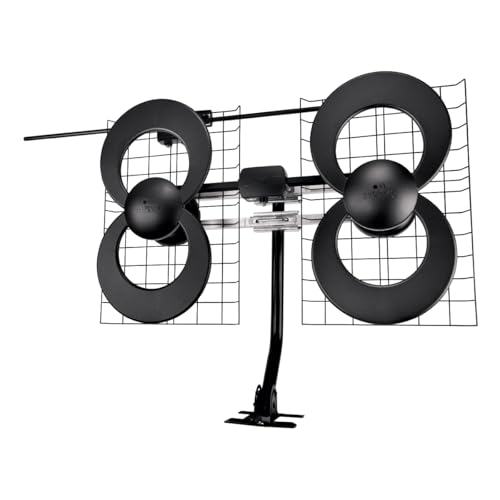
Best For: Attic, roof, or indoor-outdoor placements with long-range needs. The ClearStream 4V uses four patented loops to bring in signals up to 70+ miles, accommodating NEXTGEN TV, 4K, 8K UHD, and standard HD. Its sturdy design suits installations in varied environments, including suburban homes and rural outbuildings.
Why Selected: This antenna is designed for multi-directional reception improvements and high-quality signal capture without excessive complexity. Its form factor supports flexible placement, which helps optimize performance where unobstructed line-of-sight is limited.
Caution: Large dimensions may require proper mounting space and secure installation to withstand wind or weather.
Mornixol Outdoor TV Antenna

Best For: Quick, tool-free installation with weather resistance. The Mornixol antenna is designed for 70-mile reception, focusing on stable local channels like ABC, CBS, NBC, Fox, and PBS. It is built to withstand rain, snow, wind, and sun with IPX5-rated materials, making it a dependable choice for year-round outdoor use.
Why Selected: It emphasizes easy mounting and durability, ideal for buyers who want a simple setup process without drilling or extra tools. The weather-resistant construction supports long-term outdoor use in various climates.
Caution: To maximize signal, place away from canyons and nearby metal structures that can create interference or shadowing of broadcast towers.
Buying Guide: How To Choose The Right Outdoor TV Antenna
- Range And Terrain: Consider your distance to local towers and any obstacles (hills, trees, buildings). Antennas with 70–150 miles range are suitable for many suburbs, while very rural areas may need higher-gain models.
- Reception Type: If your area has many towers in different directions, look for omni-directional or motorized rotation options. For a single strongest signal, a directional antenna may suffice.
- Installation Location: Roof, attic, balcony, or yard placement affects performance. Attics offer protection but can reduce signal slightly; outdoors typically yields better reception but requires weatherproofing.
- Durability: Weather resistance and UV stability matter for long-term outdoor use. Check IP ratings and material quality for snow, rain, or sun exposure.
- Compatibility: Ensure the antenna supports current broadcast standards (HD, 4K, 8K) and is compatible with your TV’s coax connection and any required amplifiers.
- Installation Simplicity: If you prefer a quick setup, prioritize antennas advertised as easy-install, with remote rotation or simple mounting hardware.
- Number Of TVs: Some models support multiple sets via splitters; others are designed for one TV. Match to your household’s needs.
- Aesthetics And Size: Larger antennas may deliver better signal but require more space and mounting support. Consider wind loading and roof lines in your home design.
Frequently Asked Questions
- Do outdoor antennas require a converter box? Most modern TVs include built-in tuners, and standard coax connections are compatible with OTA antennas; a converter box is generally unnecessary.
- Will I get local channels in HD everywhere? Local channel availability depends on proximity to towers and line-of-sight; many users get 1080p HD from major networks if the signal is strong.
- Is there a best antenna for mountainous regions? Antennas with higher gain and directional options, including motorized rotation, tend to perform better when towers are in specific directions and obstructed by terrain.
- Can I install an antenna indoors? Indoor placements are possible but typically yield weaker results; attic or exterior mounting offers more consistent reception in most cases.
- Do amplified antennas perform better? Amplification can improve reception for distant or weak signals, but it can also amplify noise. Use amplification when you notice signal loss in your area.
- What maintenance is required? Regular checks for loose mounts and weatherproofing are sufficient; dusting and tightening fittings help maintain performance over time.